
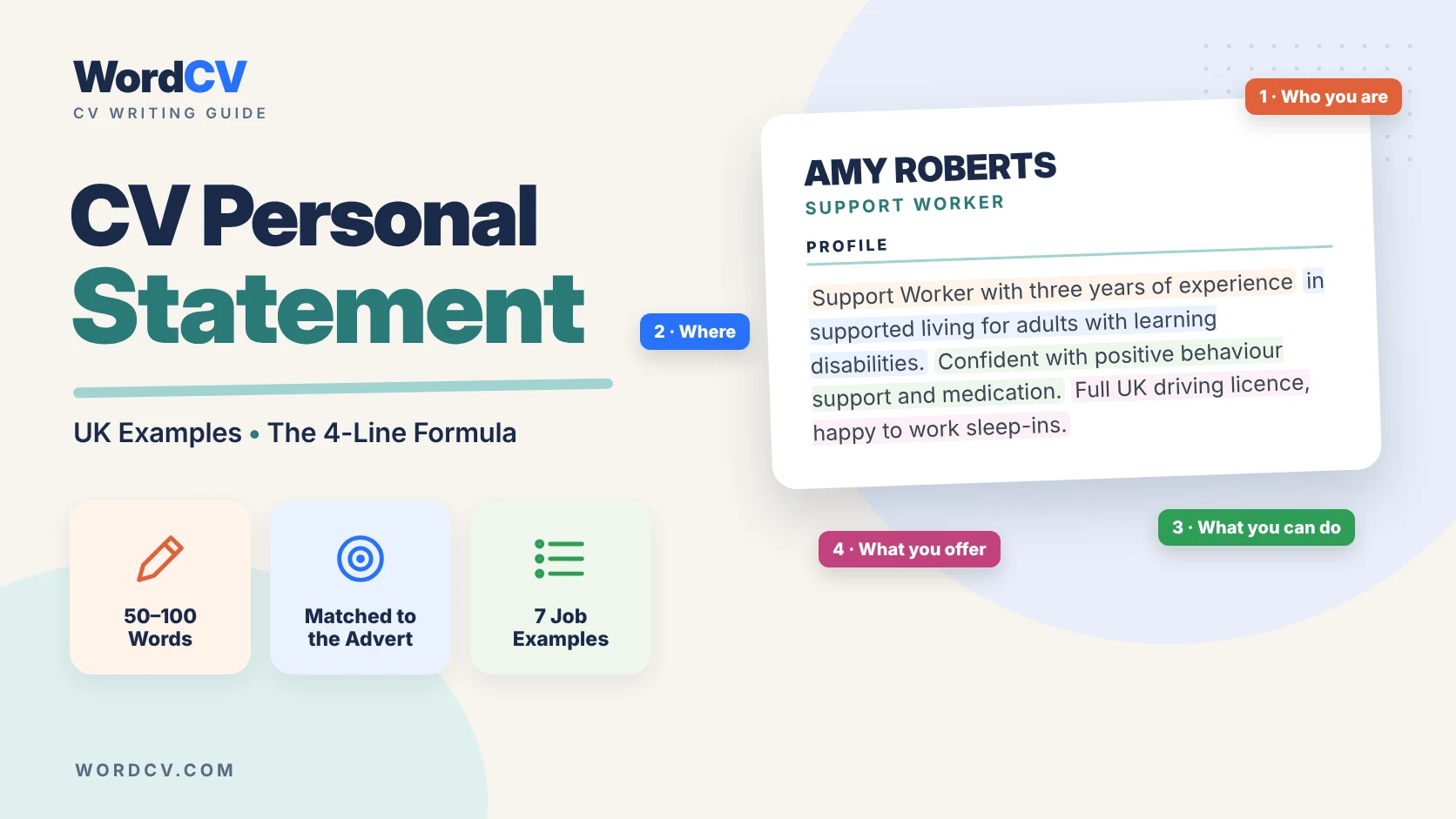
A CV personal statement is the short paragraph under your name that tells the reader who you are and why you fit the job. It is usually the first thing they read and sometimes the only thing, so it needs to do a lot in three or four lines.
Most advice on personal statements is generic. This guide is based on something more specific: the job adverts we have analysed for our CV examples, from care homes and supported living services to warehouses, dental practices and schools. Seeing what employers actually ask for makes it much easier to write a statement that answers them.
What Is a CV Personal Statement?
A personal statement, also called a profile or professional summary, is a short paragraph at the top of your CV. In the UK the three names mean the same thing. Its job is to summarise who you are, what you offer and what kind of role you want, so the reader knows how to read the rest of the page.
It is not the same as a university personal statement, which is a long essay. A CV statement is normally 50 to 100 words.
Do You Need a Personal Statement on Your CV?
For most UK CVs, yes. A recruiter or manager often decides in seconds whether to keep reading. A clear statement makes that decision easy, especially if your job titles do not obviously match the role, if you are changing career or if you have little work experience.
You could leave it out if your CV is very short and your most recent job title is exactly the job you are applying for. Even then, a two-line statement that names your licences, systems or availability can save the reader a search.
What Employers Look For First
Across the job adverts we have read for wordcv.com, the facts employers wanted quickly were surprisingly practical. They were rarely about personality.
| Job | What adverts most often asked for | What the statement should mention |
|---|---|---|
| Support Worker (6 adverts) | Driving licence (6 of 6), sleep-ins (6 of 6) | Who you have supported, driving, sleep-ins |
| Warehouse Operative (6 adverts) | Accuracy (6 of 6), counterbalance forklift (6 of 6) | Licences, equipment, shifts, accuracy |
| Receptionist (7 adverts) | Named software (7 of 7), previous experience (6 of 7) | Type of front desk, systems you use |
| Care Assistant (8 adverts) | Personal care (7 of 8), training provided (7 of 8) | Who you have cared for, shifts, training |
The lesson is simple. Before you write a word, read the advert and pick out the two or three facts that matter most for that job. Those facts belong in your personal statement.
The 4-Line Formula
Most good statements answer four questions, roughly one per line:
- Who are you? Your job title or the role you are moving into, and how long you have done it.
- Where and with whom? The setting, sector or type of customer, patient or person you have worked with.
- What can you do? Two or three specific skills, licences, systems or achievements from the advert.
- What do you want or offer next? Availability, a qualification you hold, or the kind of role you are looking for.
You do not have to follow this order exactly, but if one of the four is missing the statement usually feels thin.
Weak vs Stronger Personal Statements
Most weak statements fail in the same way: they describe qualities instead of evidence.
Weak: I am a hard-working, reliable and motivated individual with excellent communication skills who works well in a team and on my own. I am looking for a challenging role where I can develop my skills.
Every one of those words could apply to anyone. Compare a version for a warehouse job:
Stronger: Warehouse Operative with five years of experience in distribution and food warehouses. Holds in-date counterbalance and reach truck licences and is experienced in goods in, picking with handheld scanners and loading HGVs. Available for rotating day, back and night shifts.
The second version is not more impressive because of the language. It is better because it answers the questions the advert asked.
Personal Statement Examples
These examples are fictional. Change the details to match your own experience and the advert you are answering.
Support Worker
Support Worker with three years of experience in supported living for adults with learning disabilities and autism. Confident following positive behaviour support plans, administering medication and helping people build everyday life skills. Full UK driving licence, happy to work sleep-ins, weekends and lone shifts.
See the full Support Worker CV example.
Warehouse Operative, no experience
Reliable candidate looking for a first warehouse role. Brings two years of retail stock work using handheld scanners and pallet trucks, and a full attendance record over the last year. Available for days, backs, nights and weekends and keen to train for a counterbalance licence.
See the full Warehouse Operative CV example.
Receptionist
Dental Receptionist with four years of experience in a mixed NHS and private practice using Dentally. Experienced in managing the appointment book for five clinicians, taking payments and explaining treatment plans and fees. Calm with anxious patients and careful with confidential records.
See the full Receptionist CV example.
Care Assistant
Care Assistant with two years of experience in a residential home for older people, including people living with dementia. Confident with personal care, hoist transfers and electronic care records. Holds the Care Certificate and is available for days, nights and weekends.
See the full Care Assistant CV example.
Teaching Assistant
Teaching Assistant with three years of experience in a primary school, supporting small groups in phonics and maths and one-to-one support for a pupil with an EHCP. Holds a Level 3 Certificate in Supporting Teaching and Learning.
See the full Teaching Assistant CV example.
Graduate
Business Management graduate with a 2:1 from the University of Leeds and a year of part-time work in a busy hotel reception. Confident with Excel and Microsoft 365, organised under pressure and looking for a graduate role in operations or customer service.
Career change
Retail Supervisor moving into HR administration after six years managing rotas, inductions and absence records for a team of 20. Completing the CIPD Level 3 Certificate in People Practice and confident with HR systems, Excel and confidential paperwork.
For more on changing direction, see our Career Change CV example.
First Person or Third Person?
Both are acceptable in the UK. Many CVs use a clipped style that drops the pronoun altogether: “Warehouse Operative with five years of experience…” rather than “I am a Warehouse Operative…” or “Daniel is a Warehouse Operative…”. This style is shorter and reads naturally. Whatever you choose, keep it the same all the way through. Third person with your own name tends to sound odd on a CV.
How Long Should a CV Personal Statement Be?
Aim for three to five lines, or about 50 to 100 words. If it runs longer, it usually contains qualities without evidence that can be cut. If it is only one line, check that it says something the job title above it does not.
How to Tailor Your Statement to Each Job
A personal statement is the easiest part of the CV to tailor, because it is short. For each application:
- read the advert and underline the essential requirements;
- check that your statement covers the two or three most important ones honestly;
- use the employer’s words where they are accurate for you, such as “sleep-ins”, “counterbalance” or “Dentally”;
- remove anything that does not help with this particular job.
| Line from an advert | How a statement could answer it |
|---|---|
| “Full UK Driving Licence Required” (Support Worker, Whitchurch) | …Full UK driving licence and happy to drive a minibus. |
| “Valid Counterbalance FLT Licence (in date)” (Warehouse, Billingham) | …Holds an in-date counterbalance licence (2025). |
| “Strong working knowledge of SOE Exact software” (Dental Receptionist, Marylebone) | …Three years using SOE Exact to manage appointments and payments. |
Do not copy requirements you cannot meet. A statement that claims a licence or system you do not have will be found out quickly.
Words and Phrases to Avoid
| Instead of | Try |
|---|---|
| Hard-working and motivated | A fact that shows it, such as shifts worked or targets met |
| Excellent communication skills | Who you communicate with and how, such as families, patients or callers |
| Team player | The size or type of team, or a task you shared |
| Looking for a challenging role | The type of role and setting you want |
| Passionate about… | What you have done that shows the interest |
Common Personal Statement Mistakes
- Writing it first. It is often easier to write once the rest of the CV is finished, so you can summarise it.
- Using the same statement for every job. Small changes for each advert make a real difference.
- Listing qualities, not evidence. Every adjective should be backed by something on the CV.
- Making it too long. A dense paragraph is skimmed or skipped.
- Including personal details. Age, marital status and photos are not expected on a UK CV.
- Inventing figures. Use numbers only if they are accurate and you can explain them.
Personal Statement Checklist
- Does it say who you are and what job you do or want?
- Does it mention the setting or type of work?
- Does it include two or three facts the advert asked for?
- Is it 50 to 100 words?
- Have you used the same person (first, third or no pronoun) throughout?
- Have you removed any claim you cannot back up?
CV Personal Statement FAQs
What is a good personal statement for a CV?
One that says who you are, where you have worked, two or three specific things you can do and what you are looking for, in three to five lines. The best statements answer the advert directly.
Is a personal statement the same as a CV profile?
Yes. In the UK, personal statement, profile and professional summary all mean the short paragraph at the top of a CV.
How do I write a personal statement with no experience?
Focus on what you do have: volunteering, part-time jobs, courses, a driving licence, availability. Say what kind of role you want and why you are a practical fit. Our no experience CV template shows how this looks on the page.
Should I write my personal statement in first person?
You can, but many UK CVs drop the pronoun to keep it short. The most important thing is to be consistent.
How many words should a CV personal statement be?
About 50 to 100 words, or three to five lines.
Where does the personal statement go on a CV?
Directly below your name and contact details, before your work experience or education.
How we researched this guide
The requirement counts in this guide come from the job adverts we read for our Care Assistant, Support Worker, Warehouse Operative and Receptionist CV examples in 2025 and 2026. The examples are fictional. Last checked: November 2026.
More CV writing guides: CV Writing Guide · How to Edit a CV Template in Word · Why a CV Moves to a Second Page
Put Your Personal Statement Into a Word CV
Pick a template, write your four lines, and adjust them for each job you apply for.