
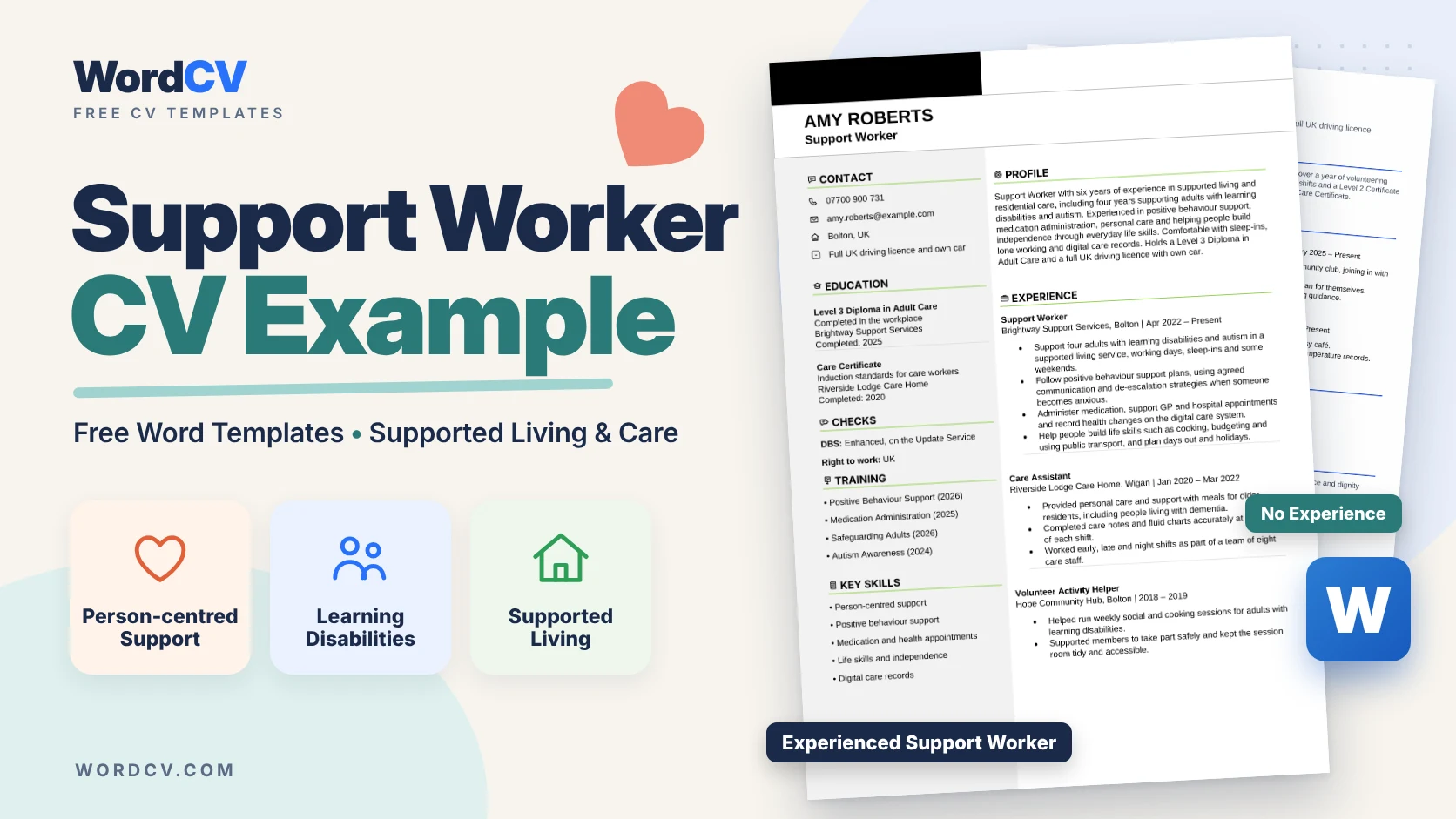
A Support Worker CV is read by someone deciding whether to trust you in a person’s own home. That is different from most jobs. The manager wants to see that you will respect the person’s choices, follow their support plan and turn up for a sleep-in when the rota says so.
We read six Support Worker adverts for supported living and residential services in England before writing this page. The Support Worker CV example below, and the version for people with no experience, answer what those employers actually asked for. Two things stood out straight away: every advert mentioned driving, and every advert mentioned sleep-ins.
Applying to a care home rather than supported living? Our Care Assistant CV example is a closer fit.
Support Worker CV Templates for Word (Free Download)
Both files are finished, editable Microsoft Word documents on A4 paper. They use no tables or text boxes, so the text reads in the right order in applicant tracking systems.
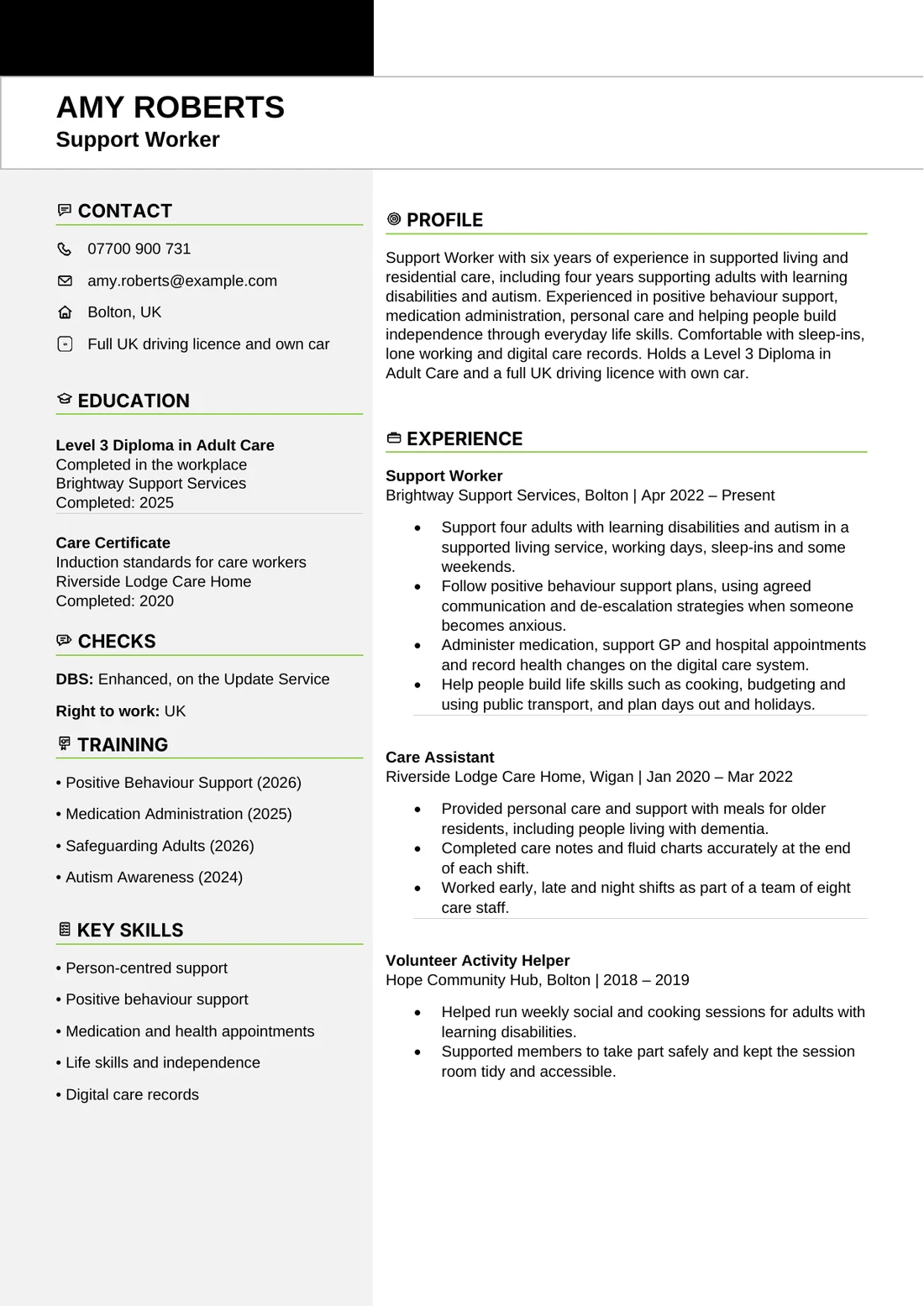
Experienced Support Worker CV
A two-column layout for support workers with supported living or residential experience, positive behaviour support and medication training.
Support Worker CV With No Experience
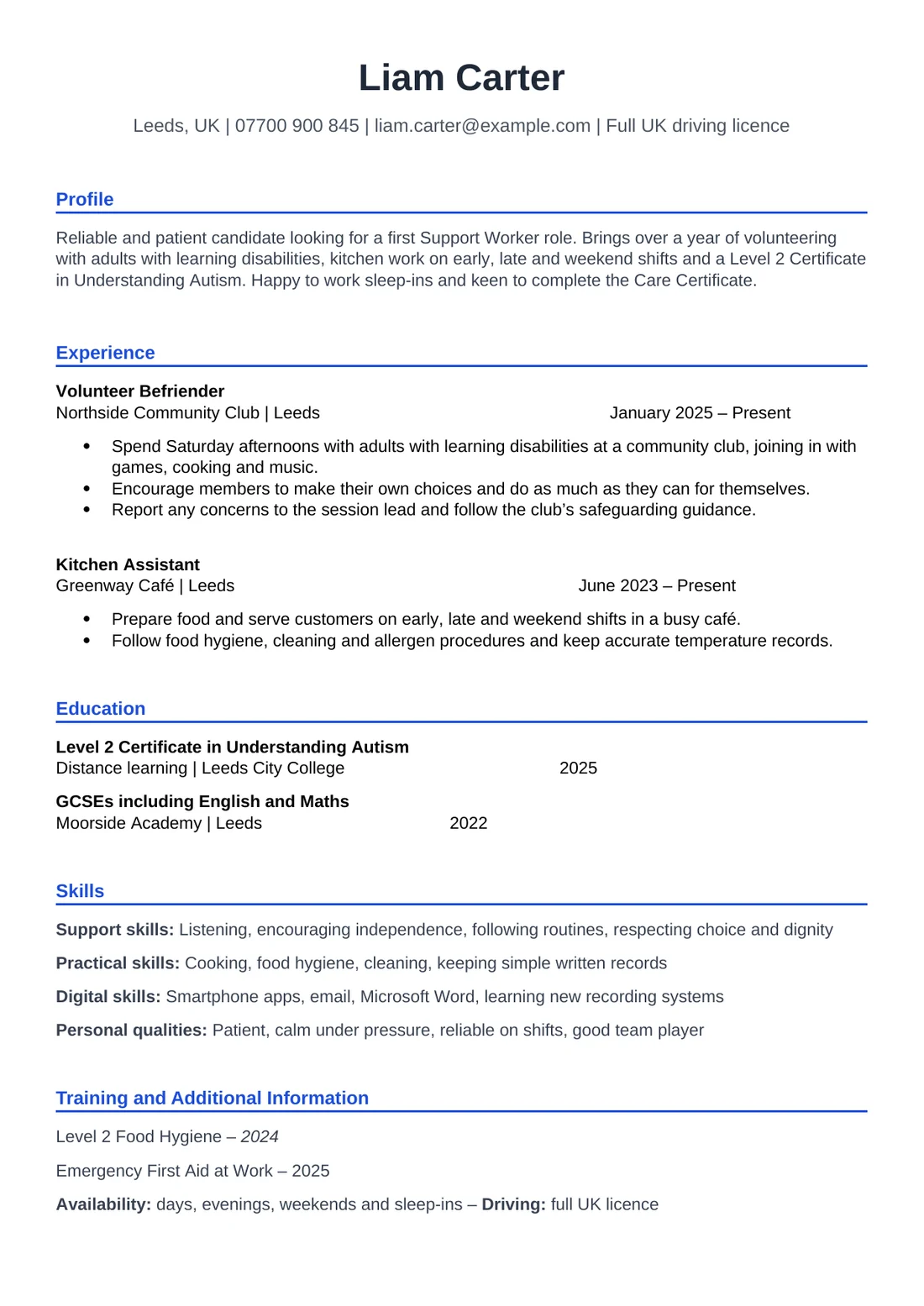
A single-column CV for a first support role, built on volunteering, shift work in a café and a short autism course.
What Support Worker Adverts Ask For
The six adverts came from supported living and residential services in Hertfordshire, Bradford, Sheerness on the Isle of Sheppey, Knowsley near Liverpool, Whitchurch in Shropshire and Burghfield in Berkshire. Three were posted by private care companies, two by not-for-profit providers and one by a recruitment agency. All of them supported adults with learning disabilities, and most also mentioned autism, mental health needs or complex needs. Pay ranged from £12.21 to £13.32 an hour.
| What the advert mentioned | How many adverts |
|---|---|
| Sleep-ins (required, offered or “where applicable”) | 6 of 6 |
| Driving licence (essential in four, preferred in two) | 6 of 6 |
| Experience not essential, preferred or “welcome” | 5 of 6 |
| Autism, complex needs or behaviour that challenges | 5 of 6 |
| Communication skills | 4 of 6 |
| Patience named as a quality | 4 of 6 |
| Enhanced DBS (two employers paid for it) | 3 of 6 |
| Care qualification (always desirable, never required) | 3 of 6 |
| IT skills | 1 of 6 |
| A CV requested | 0 of 6 |
Driving was the surprise. In a care home it rarely matters, but in supported living you take people to appointments, college, the shops and days out. Four adverts made a licence essential. One wanted someone “willing to drive a minibus”; another said “A confident driver is needed to support outings using a transit-sized vehicle” and specified a manual licence. A provider in Bradford asked for a clean manual licence and “a minimum of one-year driving experience”. If you drive, this belongs near the top of your CV, not buried at the end.
Sleep-ins came up in every advert, often with a separate rate: £50, £63 and £67.50 a night in three of them, and £113.85 in another. One service built a weekly sleep-in into the advertised salary. Saying that you can work sleep-ins is a practical answer to a real staffing problem.
Experience was less of a barrier than many people assume. Five of the six adverts said it was not essential, preferred, or simply “welcome”, usually alongside a promise of full training. Only the Knowsley advert asked for two years of support work. Qualifications followed the same pattern. They came up in three adverts: a Level 2 or 3 in Health and Social Care was “desirable” in one, a level 2 or 3 in autism or learning disabilities was “helpful” in another, and the third described the Care Certificate as “not essential”.
The personal qualities were strikingly consistent. “Kindness and patience”, “Caring, patient, and reliable”, “calm, patient and reliable”, “Kind, patient, and reliable”. You cannot prove patience with an adjective, but you can describe a situation where you needed it.
None of the six adverts asked for a CV. Most used an online application with screening questions; one asked whether the applicant had lived in the UK for five consecutive years, which is often linked to background checks. A CV is still the document you copy from when you fill those forms in, and agencies usually want one.
What Should a Support Worker CV Show?
Read across the adverts and a manager is looking for answers to five questions. Who have you supported, and with what needs? Do you understand that the job is about helping someone live their own life, not doing things for them? Can you follow a support plan, including a positive behaviour support plan? Can you drive and work sleep-ins, lone shifts and weekends? And will you be reliable?
Notice what is missing from that list: a long run of qualifications. Values and practical availability matter more at the shortlisting stage. Your CV should make both easy to find.
Support Worker CV Example
This is the text of the experienced Support Worker CV above. The person is fictional; the structure is the point.
Contact details
Amy Roberts
Bolton, UK
07700 900 731
amy.roberts@example.com
Full UK driving licence and own car
Profile
Support Worker with six years of experience in supported living and residential care, including four years supporting adults with learning disabilities and autism. Experienced in positive behaviour support, medication administration, personal care and helping people build independence through everyday life skills. Comfortable with sleep-ins, lone working and digital care records. Holds a Level 3 Diploma in Adult Care and a full UK driving licence with own car.
Experience
Support Worker
Brightway Support Services, Bolton
April 2022 – Present
- Support four adults with learning disabilities and autism in a supported living service, working days, sleep-ins and some weekends.
- Follow positive behaviour support plans, using agreed communication and de-escalation strategies when someone becomes anxious.
- Administer medication, support GP and hospital appointments and record health changes on the digital care system.
- Help people build life skills such as cooking, budgeting and using public transport, and plan days out and holidays.
Care Assistant
Riverside Lodge Care Home, Wigan
January 2020 – March 2022
- Provided personal care and support with meals for older residents, including people living with dementia.
- Completed care notes and fluid charts accurately at the end of each shift.
- Worked early, late and night shifts as part of a team of eight care staff.
Volunteer Activity Helper
Hope Community Hub, Bolton
2018 – 2019
- Helped run weekly social and cooking sessions for adults with learning disabilities.
- Supported members to take part safely and kept the session room tidy and accessible.
Education
Level 3 Diploma in Adult Care – completed in the workplace, Brightway Support Services, 2025
Care Certificate – Riverside Lodge Care Home, 2020
Checks
Enhanced DBS, on the Update Service • Right to work in the UK
Training
Positive Behaviour Support (2026) • Medication Administration (2025) • Safeguarding Adults (2026) • Autism Awareness (2024)
Key skills
Person-centred support • Positive behaviour support • Medication and health appointments • Life skills and independence • Digital care records
Support Worker CV Profile Examples
Three or four lines is enough. Name the people you have supported, one or two things you do well, and the shifts or driving the employer will want to know about.
Supported living, learning disabilities
Support Worker with three years of experience in supported living for adults with learning disabilities. Confident following support plans, prompting medication and helping people with cooking, shopping and travel. Full UK driving licence, happy to drive a minibus and to work sleep-ins and weekends.
Mental health supported housing
Support Worker with two years of experience in supported housing for adults with mental health needs. Experienced in key work sessions, support with tenancies and benefits, and recognising early signs that someone is becoming unwell. Calm in a crisis and confident working alone on late shifts.
First role in support work
Reliable and patient candidate looking for a first Support Worker role. Brings a year of volunteering with adults with learning disabilities and shift work in a busy café. Full UK driving licence, available for sleep-ins and keen to complete the Care Certificate.
Support Worker Skills for a CV
Support work has its own language, and using it accurately shows you understand the job. Avoid stacking adjectives; describe what you did instead.
| Generic wording | More useful wording |
|---|---|
| Caring and compassionate | Supporting people to make their own choices about meals, activities and routines |
| Good with challenging behaviour | Following positive behaviour support plans and agreed de-escalation strategies |
| Independent worker | Lone working on sleep-ins and late shifts, using the on-call system when needed |
| Good communicator | Using Makaton, picture cards or simple language to suit each person |
| Organised | Arranging GP, dentist and hospital appointments and recording outcomes |
| Flexible | Working days, sleep-ins, weekends and bank holidays on a rota |
Write About Independence, Not Just Tasks
This is the difference between a support CV and a care CV. In supported living, you are there to help someone do things for themselves where they can. One advert asked for values “aligned with promoting independence, dignity, and inclusion”. Another described the aim as helping people “live independently”.
Weak: Cooked meals and did shopping for service users.
Stronger: Supported a young man with autism to plan a weekly menu, shop with a list and cook three meals a week on his own.
The stronger line tells the reader what changed for the person. If you can, use one example like this in each job. Keep it anonymous: no names, no details that could identify someone.
Positive Behaviour Support and Behaviour That Challenges
Five of the six adverts mentioned autism, complex needs or behaviour that challenges, and one listed “Past experience of assisting people with intellectual disabilities and challenging behaviour” as preferable. Many services now use the term “behaviour that challenges” rather than “challenging behaviour”, because the focus is on what the person is communicating.
If you have this experience, say what you did in calm, specific language: followed a positive behaviour support plan, recognised early signs of distress, used agreed strategies, recorded incidents. Name any training, such as Positive Behaviour Support or a restrictive practice course your employer uses. If you have not had this training yet, do not imply that you have. Saying you are keen to complete it is honest and still useful.
Driving, Sleep-ins and Lone Working
These three practical points decided a lot in our sample, so give them a proper place on the CV. A single line in the profile is a good start; a short “Additional information” section at the end makes them easy to check.
- Driving: say whether you hold a full UK licence, whether it is manual, and whether you have your own car. If you have driven a minibus or larger vehicle, mention it.
- Sleep-ins: say that you can work them, and roughly how often if you already do.
- Lone working: if you have covered shifts on your own, say so. It shows the employer you can be trusted to make decisions and follow procedures without a colleague next to you.
If you do not drive, leave it out rather than writing “no licence”. Some services will still consider you, and you can explain at interview.
Support Worker CV With No Experience
Most of the adverts we read welcomed people without support work experience. What they wanted instead was evidence of kindness, patience, reliability and a willingness to learn. Places to find that evidence include:
- volunteering with disabled adults, young people, older people or a community group;
- supporting a family member, described honestly as unpaid caring;
- jobs with early, late and weekend shifts, such as hospitality, retail or warehouse work;
- any training you have done yourself, such as an autism awareness course, first aid or food hygiene;
- a driving licence, which can make up for a lot in supported living.
The second download on this page shows a first-role CV built this way. If you are moving from a completely different career, our career change CV example shows how to bring transferable skills forward.
Supported Living, Residential or Mental Health Roles?
“Support Worker” covers several different jobs. Adjust which experience you put first depending on the service.
| Service | What to bring forward |
|---|---|
| Supported living (learning disabilities, autism) | Independence and life skills, positive behaviour support, driving, sleep-ins, activities and appointments |
| Residential home | Personal care, medication, working with a larger team, nights and handovers |
| Mental health supported housing | Key work, tenancy and benefits support, risk awareness, calm communication and lone working |
| Children’s residential | Safeguarding children, routines, education support and the Level 3 Diploma for Residential Childcare |
Support Worker Qualifications and Training
None of the six adverts required a qualification, but listing what you have still helps, especially with dates. Useful items include:
- Care Certificate, usually completed during induction;
- Level 2 or Level 3 Diploma in Adult Care, or an older NVQ in Health and Social Care;
- autism or learning disability qualifications, which one advert called “helpful”;
- Positive Behaviour Support, safeguarding, medication and first aid training;
- any training your employer uses for physical intervention, if you have it.
Three adverts mentioned an enhanced DBS check, and two employers said they would pay for it. You can write that you hold an enhanced DBS or are on the Update Service, but leave out the certificate number.
How to Tailor Your CV to a Support Worker Vacancy
Take three or four lines from the advert and make sure your CV answers each one with something real. Here are lines from our sample and one way to answer them:
| Line from the advert | How a CV could answer it |
|---|---|
| “Full UK Driving Licence Required” and “Must be willing to drive a minibus” (Whitchurch) | Full UK driving licence (manual) and own car. Regularly drove a seven-seat vehicle for outings and appointments. |
| “Values aligned with promoting independence, dignity, and inclusion.” (Hertfordshire) | Help people build life skills such as cooking, budgeting and using public transport, and support them to make their own choices. |
| “Past experience of assisting people with intellectual disabilities and challenging behaviour (preferable)” (Sheerness) | Follow positive behaviour support plans for two people with autism, using agreed strategies and recording incidents accurately. |
| “Flexible to work shifts, weekends, and sleep-ins” (Whitchurch) | Available for days, sleep-ins, weekends and bank holidays. |
If you cannot meet a requirement honestly, leave it out. A clear CV with fewer, true claims is more convincing than one that tries to tick every box.
Format, Length and File Type
Use a reverse-chronological layout: contact details, profile, experience, then education, training and additional information. One page works for most first roles; two pages are fine if you have several support jobs and a long training record. Save in Word unless the employer asks for PDF.
If you prefer a single-column layout for online forms, see our ATS-friendly CV template for Word. If something moves onto a second page, read why a CV moves to a second page in Word.
Common Support Worker CV Mistakes
- Writing “service users” in every line. It is not wrong, but “the people I support” reads more naturally and matches how many providers now write.
- Describing tasks, not outcomes. Say what changed for the person, not only what you did.
- Hiding the driving licence. In our sample it was the most common practical requirement.
- Not mentioning sleep-ins. Every advert asked about them.
- Claiming training you have not done. Positive behaviour support and medication training are checked.
- Sharing identifiable details. Never name the people you support or the address of a service.
Support Worker CV Checklist
- Does your profile say who you have supported, or why you want to start?
- Have you shown how you help people become more independent?
- Is your driving licence clear, including manual or automatic?
- Have you said you can work sleep-ins, weekends and lone shifts if that is true?
- Are training courses listed with dates?
- Have you mentioned your DBS without the certificate number?
- Have you checked whether the employer uses its own application form?
Support Worker CV FAQs
What should I put on a Support Worker CV?
A short profile, your support or care experience, examples of how you helped people become more independent, training with dates, your driving licence and the shifts you can work.
Can I get a Support Worker job with no experience?
Often, yes. Five of the six adverts we read said experience was not essential, preferred or welcome, and most offered full training. Use volunteering, shift work and any caring you have done as evidence.
Do I need a driving licence to be a Support Worker?
Not always, but it helps a great deal in supported living. Every advert in our sample mentioned driving, and four made it essential.
What is a sleep-in?
A sleep-in is an overnight shift where you sleep at the service and are available if someone needs help. Providers usually pay a flat rate for it. All six adverts we read mentioned them.
Should I put my DBS on my CV?
You can say you hold an enhanced DBS or are on the Update Service. Do not include the certificate number.
Can I download a Support Worker CV template in Word?
Yes. This page has two free DOCX files: an experienced Support Worker CV and a Support Worker CV with no experience. Both open and edit in Microsoft Word.
How we researched this guide
We read six Support Worker adverts for supported living and residential services in England, published on Find a Job, a charity jobs board and a recruitment agency site during 2026, and counted how often each requirement appeared on the advert page. Quotes are copied from the adverts. Last checked: November 2026.
Related CV examples: Care Assistant CV · Nurse CV · Teaching Assistant CV · Career Change CV
Create Your Support Worker CV in Microsoft Word
Pick a clear Word layout, show how you help people live their own lives, and make your driving and availability easy to find.