

UK NURSE CV EXAMPLE & WRITING GUIDE
A strong nursing CV should make your registration, field of practice, clinical setting and relevant experience easy to understand. It should also show how you contribute to safe, person-centred care rather than simply listing routine nursing duties.
What Makes a Nursing CV Different?
A nurse CV is not simply a general CV with “patient care” added to the work experience section.
The reader may need to establish quickly:
- whether you are currently registered to practise where registration is required;
- your field of nursing practice;
- the clinical settings in which you have worked;
- the patient groups you have supported;
- your level of responsibility;
- your relevant clinical competencies and training;
- your experience of assessment and care planning;
- medicines management experience where relevant to your role and competence;
- documentation and handover responsibilities;
- multidisciplinary working;
- infection prevention and control;
- safeguarding;
- risk recognition and escalation;
- professional development.
The strongest CVs connect these areas to real clinical experience instead of presenting them as an isolated list of keywords.
Nurse CV Format: What Should Go Near the Top?
A recruiter should not have to search through two pages to discover what kind of nurse you are.
Near the beginning of the CV, make the most important professional context clear. Depending on your circumstances, this may include:
- professional title;
- field of nursing;
- current NMC registration where applicable;
- years or level of relevant experience;
- main clinical setting or specialty;
- particularly relevant post-registration experience;
- the type of position you are targeting.
For example, “Registered Adult Nurse | Acute Medical Ward Experience” gives the reader more useful context than simply writing “Nurse”.
Nurse CV Profile: Replace Personality Claims With Clinical Context
“Compassionate”, “hardworking” and “excellent communicator” appear frequently in nursing CVs. These qualities are important, but a profile consisting only of personality claims gives the employer little evidence.
Weak Nurse CV Profile
Compassionate and hardworking nurse with excellent communication and teamwork skills who is passionate about providing the best possible patient care.
Stronger Nurse CV Profile
NMC-registered Adult Nurse with four years of post-registration experience across acute medical and respiratory wards. Experienced in patient assessment, care planning, medicines management, clinical documentation, escalation of deterioration and multidisciplinary working, with current experience supporting patients with complex and changing care needs.
The stronger version tells the employer where the nurse has worked, the level of experience involved and the areas of practice that may be relevant to the vacancy.
Registered Nurse CV Example
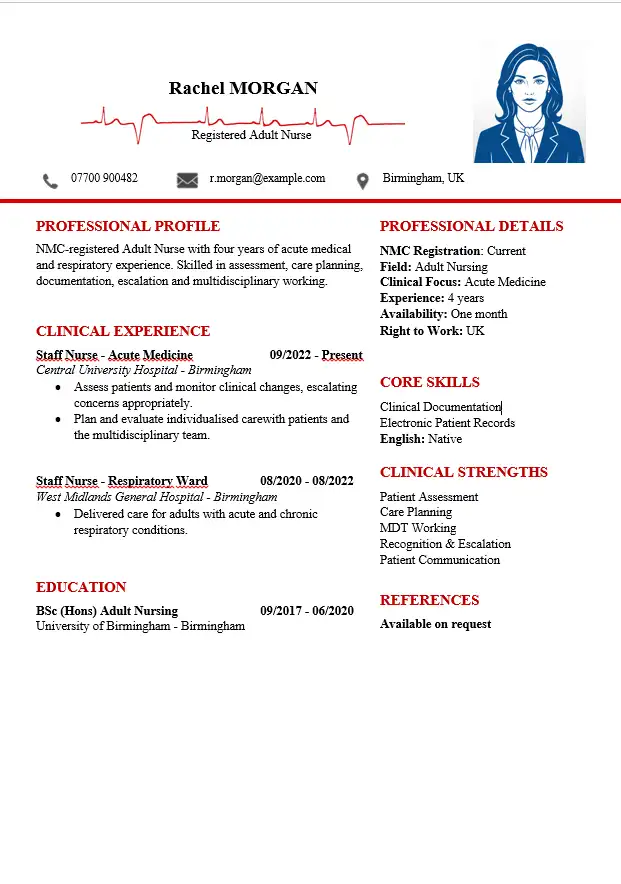
This sample CV shows how an experienced Adult Nurse can present registration, clinical environment and professional responsibilities without turning the employment section into a generic nursing job description.
Rachel Morgan
Registered Adult Nurse
Birmingham, UK
07XXX XXXXXX • rachel.morgan@example.com
Professional Profile
NMC-registered Adult Nurse with four years of post-registration experience in acute medical and respiratory care. Experienced in patient assessment, individualised care planning, medicines management, clinical documentation, recognising and escalating deterioration and coordinating care with multidisciplinary colleagues. Committed to safe, evidence-informed and person-centred practice.
Clinical Experience
Staff Nurse – Acute Medicine
Central University Hospital | Birmingham
September 2022–Present
- Assess patients on admission and throughout their stay, identifying changes in clinical condition and escalating concerns through appropriate clinical pathways.
- Plan, deliver and evaluate individualised nursing care in collaboration with patients, families and the multidisciplinary team.
- Administer medicines within professional competence and local policy, complete required checks and document care accurately.
- Provide clear verbal and written handovers to support continuity of care between shifts and clinical teams.
- Maintain accurate electronic nursing records, including assessments, interventions, risk information and changes in patient condition.
- Apply infection prevention and control procedures during routine and isolation care.
- Support students and less experienced colleagues within the limits of role and competence.
- Communicate with patients and families about nursing care, adapting explanations to individual communication needs.
Staff Nurse – Respiratory Ward
West Midlands General Hospital | Birmingham
August 2020–August 2022
- Delivered nursing care for adults with acute and chronic respiratory conditions in a busy inpatient environment.
- Monitored observations and clinical changes and escalated deterioration promptly to senior nursing and medical colleagues.
- Contributed to discharge planning and worked with multidisciplinary services to support safe transitions of care.
- Provided patient education relating to treatment, medication and ongoing care within the boundaries of the nursing role.
- Participated in ward quality, safety and infection-prevention activities.
Registration & Education
NMC Registered Adult Nurse
Current registration
BSc (Hons) Adult Nursing
Example University | 2017–2020
Relevant Professional Development
- Safeguarding Adults
- Infection Prevention and Control
- Basic or Immediate Life Support as applicable to current employment
- Medicines Management
- Recognition and Escalation of Deterioration
Do Not Reduce Nursing Experience to “Provided Patient Care”
Almost every nursing role involves patient care. Writing only that phrase does not show your actual level or type of experience.
Too General
Provided high-quality patient care and worked with doctors and other nurses.
More Useful
Assessed adults admitted to the acute medical ward, updated nursing care plans, monitored changes in clinical condition and escalated deterioration to appropriate senior and medical colleagues.
The second version gives the reader clinical context without exaggerating the nurse’s scope of practice.
Make Your Clinical Setting Visible
Two registered nurses may have very different professional experience even when they have the same job title.
Where relevant, identify the environment in which you gained your experience, such as:
- acute medicine;
- surgical wards;
- emergency care;
- critical care;
- community nursing;
- primary care;
- mental health services;
- care homes;
- rehabilitation;
- outpatients;
- theatres;
- paediatrics;
- specialist services.
Only include specialties and environments in which you genuinely have experience.
Patient Assessment and Care Planning Belong in the Evidence
If assessment and care planning are relevant to the vacancy, show what they involve in your actual practice.
Depending on your role, useful evidence might include:
- initial and ongoing patient assessment;
- identifying nursing needs;
- planning and evaluating care;
- monitoring clinical changes;
- risk assessment;
- discharge planning;
- patient and family involvement;
- multidisciplinary care coordination.
Do not claim responsibility for assessments, diagnoses or treatment decisions outside your actual role and competence.
Clinical Documentation Is a Nursing Skill, Not an Admin Detail
Accurate documentation supports continuity, communication and patient safety. If record keeping is relevant to the role, it deserves more than a generic “good IT skills” statement.
You may be able to show experience of:
- electronic patient records;
- documenting assessments and care;
- recording changes in clinical condition;
- updating care plans;
- recording risk information;
- maintaining confidentiality;
- providing clear written handovers or clinical information.
Name a specific clinical system only when you have genuinely used it and when that experience is relevant to the vacancy.
Show How You Communicate During Handover and Multidisciplinary Care
Communication on a nursing CV should be connected to care rather than presented only as a soft skill.
Relevant examples may include:
- structured shift handovers;
- sharing changes in patient condition;
- escalating concerns;
- working with doctors, therapists, pharmacists and other professionals;
- communicating with patients and families;
- adapting communication to individual needs;
- supporting discharge and transfer of care.
This makes “excellent communication skills” much more credible.
Patient Safety: Show What You Actually Do
“Patient safety” is too broad to stand alone as a CV skill.
Depending on your clinical role, relevant evidence may involve:
- recognising clinical deterioration;
- appropriate escalation;
- risk assessment;
- infection prevention and control;
- medicines safety;
- safeguarding;
- accurate documentation;
- following local policies and clinical procedures;
- raising concerns appropriately.
Choose examples that match your own scope and experience rather than trying to include every possible safety-related keyword.
Safeguarding and Infection Prevention Should Not Be Empty Keywords
Safeguarding and infection prevention frequently matter in healthcare recruitment, but simply listing them under “skills” provides little evidence.
Where relevant to your experience, your work history can show that you:
- follow safeguarding procedures;
- recognise and report concerns through appropriate channels;
- work within infection-prevention procedures;
- apply appropriate precautions;
- maintain safe clinical practice;
- complete required training and updates.
Be precise about the responsibilities you personally held.
Should You Put NMC Registration on a Nurse CV?
If current NMC registration is required for the position and you hold it, make that professional status easy to find.
For example:
NMC Registered Adult Nurse – Current Registration
A student nurse or applicant awaiting registration should describe their status accurately rather than presenting themselves as currently registered.
Avoid placing unnecessary confidential or sensitive information in a publicly shared CV. Follow the requirements of the employer or application system when specific professional registration details are requested.
NHS Nurse CV Example: Read the Person Specification First
If you are targeting an NHS nursing post, do not start by adding as many NHS-related keywords as possible.
Start with the job description and person specification.
A nursing person specification may ask for evidence relating to areas such as:
- NMC registration;
- relevant clinical experience;
- evidence-based nursing care;
- infection prevention and control;
- safeguarding;
- communication;
- teamwork;
- workload prioritisation;
- clinical documentation;
- professional development;
- teaching, supervision or leadership for some roles.
If you meet those requirements, make the supporting evidence easy to find in your CV and application. Do not copy criteria that you cannot genuinely demonstrate.
A CV Is Not Always the Whole NHS Application
NHS recruitment can use different application routes. Depending on the vacancy, you may be asked to complete an online application and supporting information rather than simply attaching a conventional CV.
The supporting information is especially important because it allows you to demonstrate how your qualifications, knowledge, experience and skills meet the person specification.
A well-maintained nursing CV is still useful as a master document. It gives you an organised record of your:
- employment history;
- clinical experience;
- qualifications;
- training;
- professional development;
- skills and achievements.
You can then use that information to complete the application route requested by the employer.
Band 5 Nurse CV Example: What Should You Prioritise?
For a Band 5 nursing application, the vacancy’s person specification should determine what receives the most space.
Depending on the post, useful evidence may include:
- current professional registration;
- relevant placements or post-registration experience;
- patient assessment;
- care planning and evaluation;
- clinical observations and escalation;
- medicines management within competence;
- multidisciplinary working;
- communication and handover;
- infection prevention and control;
- safeguarding;
- documentation;
- organisation and prioritisation;
- commitment to continuing professional development.
Do not assume that every Band 5 role requires exactly the same evidence. A medical ward, community team, mental health service and specialist unit may have substantially different requirements.
Student Nurse CV Example UK
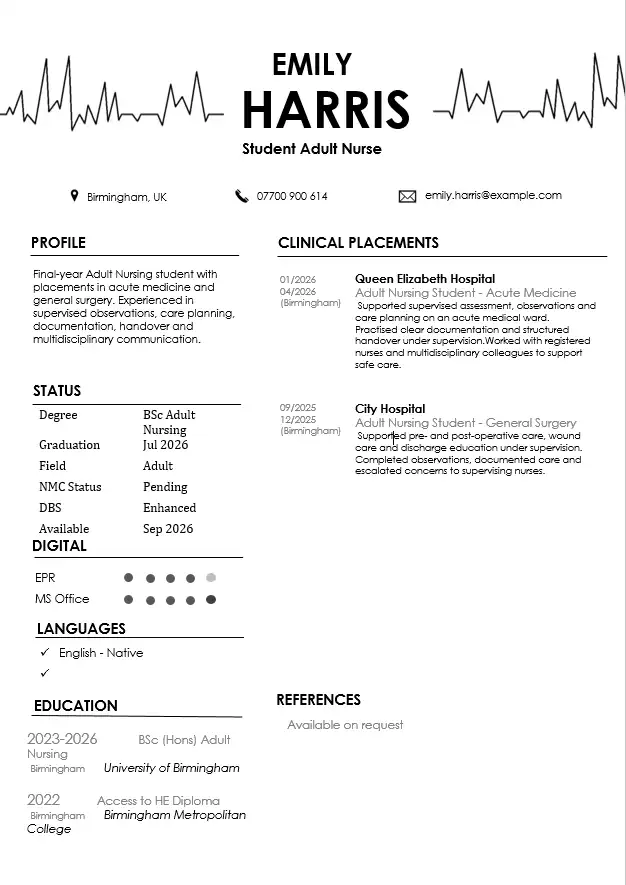
A student nurse CV should not present placements as though they were independent registered-nurse posts. Instead, use placements to show the clinical environments you have experienced and the competencies you have developed under appropriate supervision.
Useful Student Nurse CV Content
- nursing degree and expected completion date;
- field of nursing;
- clinical placements;
- placement setting and specialty;
- patient groups encountered;
- assessment and care experience under supervision;
- communication and documentation experience;
- infection prevention and safeguarding learning;
- bank healthcare support work if applicable;
- previous care work;
- relevant volunteering;
- transferable employment experience.
Student Nurse Profile Example
Final-year Adult Nursing student with clinical placements in acute medicine and general surgery. Developed supervised experience in patient assessment, care planning, clinical observations, documentation, structured handover and multidisciplinary communication, with a strong focus on safe and person-centred care.
Be explicit about what was completed under supervision and never imply independent competence that you have not yet achieved.
Newly Qualified Nurse CV Example
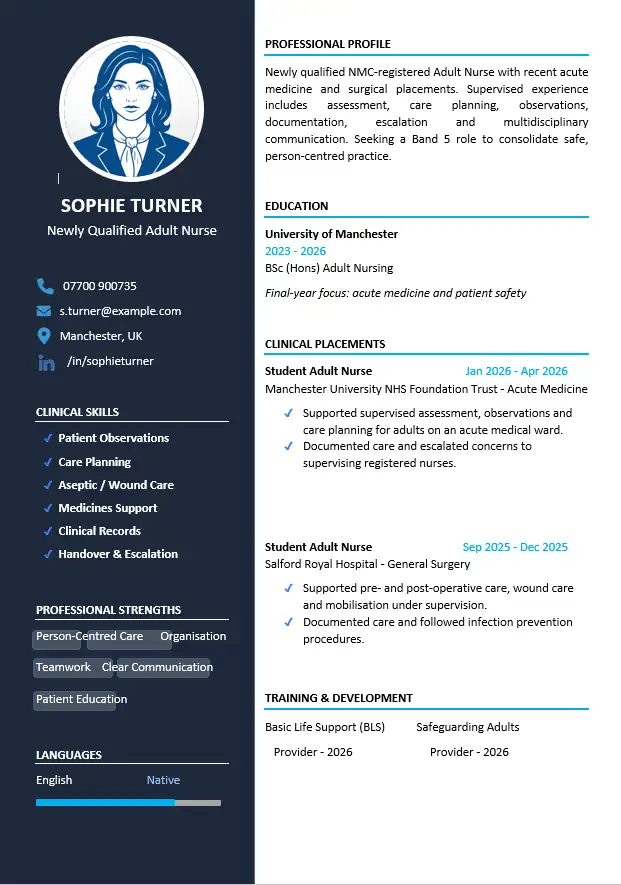
A newly qualified nurse does not need to hide the fact that they are at the beginning of their registered career.
Instead of trying to fill the CV with generic nursing statements, prioritise:
- current registration status;
- field of nursing;
- final placements;
- relevant placement specialties;
- clinical skills supported by your training and competence;
- patient assessment and care planning experience;
- safe escalation;
- documentation and handover;
- multidisciplinary teamwork;
- previous healthcare employment where applicable;
- areas in which you want to continue developing.
Newly Qualified Nurse Profile Example
Newly qualified NMC-registered Adult Nurse with recent clinical placements in acute medicine and general surgery. Developed supervised experience in patient assessment, care planning, clinical observations, documentation, escalation and multidisciplinary communication, and now seeking a Band 5 role in which to consolidate safe, person-centred practice.
Nurse Practitioner CV Example: Do Not Use a Generic Staff Nurse CV
If you are applying for a nurse practitioner or advanced clinical role, the CV should reflect the actual scope of the vacancy and your verified qualifications and competencies.
Depending on the post, relevant evidence may include:
- advanced clinical assessment experience;
- specialist clinical knowledge;
- autonomous practice where genuinely applicable;
- relevant postgraduate education;
- prescribing status where required and held;
- clinical decision-making;
- leadership;
- audit and service improvement;
- teaching and supervision.
Use the exact person specification for the role rather than assuming every nurse practitioner position has identical requirements.
Nurse Educator CV: Put Teaching Evidence Alongside Clinical Credibility
A nurse educator CV needs a different balance from a frontline staff nurse CV.
Relevant areas may include:
- clinical background;
- teaching or facilitation experience;
- student support;
- practice supervision and assessment;
- learning-resource development;
- staff training;
- simulation or skills teaching;
- quality improvement;
- audit or research activity;
- relevant education qualifications.
Do not allow a long list of teaching activities to hide the clinical background that gives those activities context.
What Skills Should a Nurse CV Include?
The strongest skills section should reflect the job you are applying for and be supported by evidence elsewhere in the CV.
Depending on your role, relevant nursing skills may include:
- patient assessment;
- care planning and evaluation;
- clinical observations;
- recognition and escalation of deterioration;
- medicines management;
- clinical documentation;
- infection prevention and control;
- safeguarding;
- patient education;
- multidisciplinary working;
- handover and communication;
- workload prioritisation;
- risk management;
- student or colleague support where relevant.
Avoid claiming specialist competencies simply because they appear in a job advertisement. Include only skills that accurately reflect your training, role and current competence.
Seven Qualities of a Good Nurse to Demonstrate in a CV
There is no single official list of seven qualities that every nurse CV must contain. For CV-writing purposes, however, the following seven areas provide a useful way to think about the evidence you present:
- Person-centred care — show how you involve and communicate with people receiving care.
- Clear communication — demonstrate handover, documentation, escalation and patient communication.
- Clinical judgement — show appropriate assessment, monitoring and recognition of changes.
- Safety and accountability — demonstrate safe practice and appropriate escalation.
- Teamwork — show how you work with nursing and multidisciplinary colleagues.
- Organisation and prioritisation — provide evidence from busy clinical environments.
- Adaptability and continuing development — show how you maintain and develop professional knowledge and skills.
It is better to prove three or four of these strongly through your experience than to list all seven as unsupported adjectives.
Should Nursing Achievements Always Include Numbers?
Not every meaningful nursing contribution can or should be reduced to a percentage.
Use numbers when they are accurate, relevant and supported by real evidence. Never invent patient-volume figures, compliance rates, incident reductions or clinical outcomes simply to make a bullet point sound stronger.
Useful evidence can also describe:
- a quality-improvement project;
- participation in an audit;
- implementation of a new ward process;
- student support;
- service development;
- patient education;
- contribution to safer or more consistent practice;
- additional responsibility within your team.
Nurse CV Template: Word or PDF?
Microsoft Word is useful while you are editing and tailoring your nursing CV because the DOCX remains editable. PDF is useful when an employer specifically requests or accepts a PDF and you want to preserve the final appearance of the document.
Always follow the application instructions. Do not assume that every NHS, private-hospital, agency or care-provider application accepts the same file format.
Keep an editable Word master copy even when the final application is submitted in another format. This makes it easier to tailor your profile, clinical experience and skills to the next vacancy.
Free Nurse CV Templates in Word Format
The downloadable examples on WordCV are designed to be edited in Microsoft Word. Rather than using one generic nursing CV for every application, choose the example closest to your career stage and clinical background and then replace all example information with your own.
Download and edit one of the following nursing CV examples:
- Registered Nurse CV Example — for an experienced registered nurse;
- Newly Qualified Nurse CV Example — for the transition from training into a first registered post;
- Student Nurse CV Example — for placements, relevant employment and early healthcare experience.
The Word documents can also be saved as PDF after you have finished editing them. Always check the final PDF before submitting it to make sure headings, dates and page breaks have remained in the correct position.
Common Nurse CV Mistakes
- Writing only “provided patient care”. Explain the clinical setting and your actual responsibilities.
- Hiding registration status. Make relevant current professional registration easy to find.
- Using a generic personal profile. Identify your field, setting and relevant experience.
- Listing every nursing skill imaginable. Only include competencies you genuinely hold.
- Ignoring patient safety evidence. Show relevant escalation, documentation, infection-control and safeguarding practice.
- Using the same CV for every specialty. An acute ward and community nursing role may require different evidence.
- Overstating student placements. Make supervised experience clear.
- Inventing statistics. Never create clinical outcomes or patient figures simply to strengthen a bullet point.
- Ignoring the person specification. Use the employer’s actual requirements to decide what should receive emphasis.
- Assuming a CV replaces the NHS application. Follow the application method specified for the vacancy.
How to Tailor a Nursing CV to a Job Description
Read the job description and person specification before editing your CV.
If a vacancy genuinely requires experience in areas such as:
- acute nursing;
- care planning;
- infection prevention;
- safeguarding;
- multidisciplinary communication;
- electronic records;
- prioritising a clinical workload;
and those requirements match your background, make that evidence prominent in your professional profile and recent employment history.
Do not simply paste the job description into the CV. The employer needs evidence that you meet a requirement, not proof that you can repeat its wording.
Nurse CV Final Checklist
- Is your nursing field or specialty clear?
- Is relevant professional registration easy to find?
- Does your profile explain your actual clinical background?
- Are your most recent and relevant roles prioritised?
- Have you identified the settings in which you worked?
- Does your experience show assessment and care responsibilities where relevant?
- Have you shown documentation and handover experience?
- Is multidisciplinary working demonstrated?
- Have you represented medicines experience accurately?
- Is infection-prevention experience supported by evidence?
- Is safeguarding represented accurately?
- Have you shown how you recognise and escalate concerns where relevant?
- Are your skills consistent with your actual competence?
- Are student placements clearly identified as placements?
- Have you tailored the CV to the person specification?
- Have you followed the employer’s application instructions?
Need a Word Template for Your Nursing CV?
Use an editable Microsoft Word CV example as a starting point, then replace every sample section with your own registration, clinical experience, education and professional development.
Nurse CV FAQs
What is the best format for a nurse CV?
A clear reverse-chronological format works well for many nurses because it makes recent clinical experience easy to find. Put relevant registration, professional profile, recent clinical employment, qualifications, skills and professional development in a logical order. The requirements of the specific vacancy should determine which sections receive the most emphasis.
How do you write a good nurse CV?
Identify your nursing field, registration status and clinical environment, then use your employment history to demonstrate relevant practice. Show assessment, care planning, documentation, communication, patient safety, multidisciplinary working and other role-specific experience rather than relying on generic statements about being compassionate or hardworking.
What is a good objective for a nurse CV?
For an experienced nurse, a short professional profile is usually more useful than a vague career objective. State what type of nurse you are, the clinical experience you bring and the type of role or environment you are targeting.
Should I include my NMC registration on my CV?
If current NMC registration is relevant or essential to the job and you hold it, make your registration status easy to identify. Students and applicants awaiting registration should describe their current status accurately.
What should a newly qualified nurse put on a CV?
Include your nursing degree, current registration status, relevant clinical placements, final-placement experience, clinical skills supported by your training, documentation, communication, multidisciplinary working and any relevant healthcare employment or volunteering.
Can a student nurse include placements on a CV?
Yes. Identify them clearly as clinical placements and explain the setting, patient group and relevant supervised experience. Do not present a placement as though it were an independent registered-nurse position.
What should a Band 5 nurse CV include?
Use the person specification for the exact Band 5 vacancy. Commonly relevant areas can include registration, patient assessment, care planning, documentation, communication, escalation, infection prevention, safeguarding, teamwork and workload prioritisation, but requirements vary between specialties and employers.
Should a nurse CV be Word or PDF?
Keep an editable Word version for updating and tailoring. Submit Word or PDF according to the employer’s instructions. If you create a PDF, check the exported document carefully before submitting it.
Do NHS nursing applications always require a CV?
No. NHS recruitment can use different application methods, including online application forms and supporting information. Always follow the instructions for the individual vacancy.
Explore More CV Examples
Teacher CV Example
See how to present teaching experience, curriculum knowledge, safeguarding and qualifications for UK schools.
Accountant CV Example
Learn how to present accounting experience, systems, qualifications and financial achievements.
Coming next