
FREE GRADUATE CV TEMPLATE FOR WORD
Just finished university and unsure how much of your degree should appear on your CV? This editable Word template shows you how to balance education, projects, internships, placements and early work experience when applying for graduate and entry-level roles.
Microsoft Word (.docx) • One page • Editable • No account required
A Graduate CV Has to Bridge Education and Work
A graduate CV sits between a student CV and an experienced professional CV. Your degree is still one of your strongest assets, but employers also want clear evidence that you can apply what you learned outside the classroom.
That evidence can come from a placement year, internship, dissertation, final-year project, part-time job or volunteering. You do not need to turn every university experience into employment language. Focus on the parts of your academic and practical background that support the role you are applying for.
Still studying and mainly applying for part-time jobs, internships or placements? Use our student CV template instead.
Graduate CV Template Preview
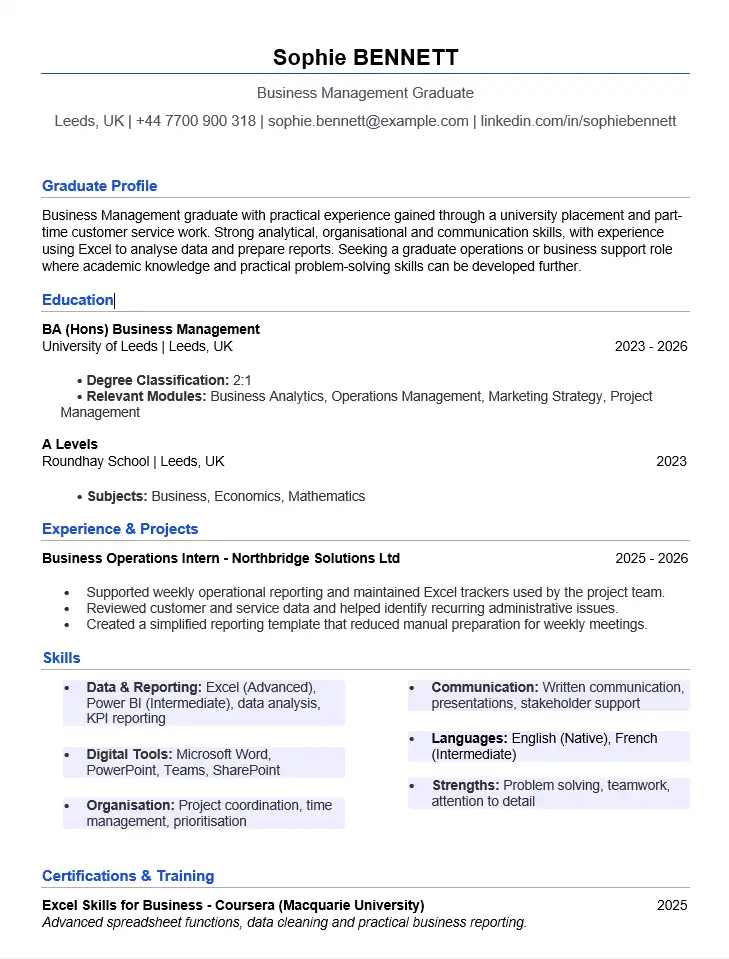
The preview below shows the exact layout included in the downloadable Word file.
Template Details
File: Microsoft Word (.docx)
Length: One page
Photo: No
Example: Business Management graduate
Best for: Graduate and entry-level roles
Account required: No
Why This Graduate Template Is Structured This Way
The example follows Sophie Bennett, a recent Business Management graduate starting her professional career. It does not pretend she has ten years of experience.
- Education stays prominent because the degree is recent and relevant.
- Experience and projects get proper space so employers can see how skills have been applied.
- Earlier school qualifications are kept brief because the degree is now the stronger academic credential.
- Skills support the application rather than replacing real evidence.
- The CV stays concise — there is no benefit in stretching limited early-career information just to fill a second page.
If you already have substantial relevant experience after graduating, move employment higher and reduce academic detail.
How Much Detail Should You Give About Your Degree?
Being a graduate does not mean copying your university transcript onto your CV. The amount of academic detail should depend on what the vacancy actually needs.
Usually include
- Degree title
- University
- Study or graduation dates
- Degree classification (when useful or requested)
UK undergraduate degrees commonly use First, 2:1, 2:2 and Third. Use the classification you were actually awarded — never convert or inflate it.
Add selectively
- Relevant modules
- Dissertation or final-year project
- Academic awards
- Industry projects
- Technical tools used during the course
A module is useful only when it supports the application. Business Analytics may help an operations or analyst role; listing every first-year module usually does not.
Should You Include Your Degree Classification?
There is no reason to hide a classification that an employer specifically asks for. Some graduate schemes set academic requirements, and your application should meet them accurately.
A clear format is:
BA (Hons) Business Management — 2:1
University of Leeds | 2023–2026
If you are still awaiting the final result, clearly distinguish an expected or predicted grade from an awarded classification. Degree classification remains relevant in the UK graduate market, although it is only one factor among many.
Placement, Internship or Part-Time Job: Which Deserves More Space?
Do not automatically rank experience by whether it was full-time or part-time. Rank it by relevance to the role.
Placement year
A sandwich year or year in industry can deserve substantial space when it gave you direct, relevant experience. Internships are especially valuable when they demonstrate sector knowledge or practical skills requested in the vacancy.
Part-time job
Do not discard retail, hospitality or customer service work just because it is unrelated to your degree. These roles can still prove communication, reliability, teamwork and responsibility. If the graduate role is customer-facing, your part-time experience may suddenly become highly relevant.
Can Your Dissertation or Final-Year Project Go on Your CV?
Yes — when the subject or the skills involved support the application. The title alone is rarely enough.
Too academic
Dissertation: The Impact of Digital Transformation on Customer Service.
More useful
Final-year research project examining how digital process changes affect customer service efficiency; analysed survey data in Excel and presented recommendations in a 9,000-word report.
The second version shows research, analysis, software use and written communication. For an unrelated role, the project may need only one line — or none at all.
How the Graduate CV Example Works
The downloadable template uses Sophie Bennett, a Business Management graduate, to show the transition from education into an entry-level professional application.
Graduate Profile
Business Management graduate with practical experience developed through university projects and early workplace roles. Confident using Microsoft Office, preparing presentations and working with business information. Strong organisation and communication skills. Seeking an entry-level business support or operations role.
The profile does more than say “recent graduate seeking opportunities”. It names the degree, useful evidence and the type of role being targeted.
Education
The degree remains visible because Sophie is at the start of her career. Earlier school qualifications receive less detail because they are no longer the strongest academic evidence.
Experience & Projects
Relevant experience and project work show how Sophie has used skills beyond simply attending university. This is far more useful than filling half the page with a long list of modules.
Do Graduate CVs Need a Personal Profile?
A short profile can help when your CV needs to connect your degree, experience and career direction quickly. It is not an excuse to fill the top of the page with generic claims.
A useful graduate profile usually answers three questions:
- What have you recently studied?
- Which experience or strengths are most relevant?
- What type of position are you targeting?
If the answers are already obvious from a strong, well-targeted CV and space is tight, the profile does not have to be the most important section.
Graduate Scheme or Ordinary Entry-Level Job?
These terms are sometimes treated as the same thing, but the application context can differ.
Graduate Scheme
A structured graduate programme may set specific eligibility criteria, academic requirements, application stages and competencies. Check these carefully before deciding which details deserve space on your CV.
Entry-Level Job
An entry-level vacancy may be open to graduates and non-graduates and often places greater weight on practical skills or existing experience than on degree details.
Having a degree does not mean the Education section must always dominate. The vacancy decides what evidence matters most.
Tailor Academic Evidence to the Graduate Role
The same graduate can legitimately emphasise different parts of the same degree for different jobs.
Business Analyst Graduate Role
- Business Analytics module
- Excel data analysis
- Research project
- Presentation of findings
- Quantitative coursework
Graduates targeting analytical roles may also find our Data Analyst CV example useful for presenting university projects, technical skills and limited professional experience.
Graduate Operations Role
- Operations Management
- Project coordination
- Placement or internship
- Process improvement project
- Teamwork and organisation evidence
Graduate Marketing Role
- Marketing Strategy
- Campaign or research project
- Presentation skills
- Customer-facing part-time work
- Relevant digital tools
Do not add a module simply because its title contains a keyword from the job advert. Include academic information only when you can explain how it supports the role.
Do Not Waste Your Part-Time Experience
A common graduate CV mistake is removing retail, hospitality or customer service work because it does not match the degree title. Relevance is more nuanced than that.
Weak: Worked in a shop while at university.
More useful: Handled customer enquiries and transactions during busy weekend periods while balancing regular shifts with full-time university study.
The second version provides evidence of customer communication, reliability and workload management. Whether those abilities matter depends on the graduate job.
How Long Should a Graduate CV Be?
Do not add a second page simply because you have graduated, and do not force everything onto one page if that means cutting strong evidence.
One page works well when:
- Your professional history is still short
- You have one or two relevant projects
- Your degree information is concise
- The strongest evidence fits comfortably without tiny text
More space may be useful when:
- You completed a substantial placement year
- You have several relevant internships
- You have significant employment alongside study
- The role requires technical projects or professional qualifications that need explanation
The downloadable example is one page because the candidate is at the beginning of her career. For a longer format, see the two-page CV template for Word.
Common Graduate CV Mistakes
- Listing every module. Keep only those that help explain suitability for the target role.
- Treating the dissertation title as self-explanatory. Explain the methods, tools or skills when they matter.
- Removing all unrelated part-time work. It may still provide relevant evidence.
- Writing “graduate” as though it were a skill. Employers still need evidence of what you can do.
- Using the same profile for every application. Different roles value different parts of your background.
- Giving old school qualifications more space than your degree. Earlier education becomes less detailed as stronger qualifications are gained.
- Inventing professional language for ordinary university activities. Describe academic work accurately.
- Sending a CV focused entirely on education. Show how your knowledge or transferable skills have been applied where possible.
- Assuming the degree alone meets every requirement. Read the vacancy carefully and respond to the actual selection criteria.
Graduate CV vs Student CV vs No Experience CV
Use this graduate CV template when you have completed (or are very close to completing) a degree and are moving towards graduate or entry-level professional employment.
Still studying and applying mainly for part-time work, internships or placements? Use the student CV template.
Main difficulty is having virtually no formal employment history? See the no experience CV template.
How to Edit This Graduate CV in Word
- Download the DOCX file and open it in Microsoft Word.
- Replace Sophie Bennett’s contact information with your own.
- Rewrite the profile around your degree, evidence and target role.
- Add your degree title, university, dates and accurate classification.
- Include only the modules, projects or dissertation information that supports the application.
- Replace the example experience and projects with your own placements, internships, employment or academic work.
- Reduce older school qualifications when your degree is now more important.
- Replace generic skills with skills relevant to the vacancy and supported elsewhere in the CV.
- Remove every piece of example information that does not belong to you.
- Check the final page layout and save a PDF copy if the employer requests PDF.
For more help with the Word file itself, see our guide to editing a CV template in Microsoft Word.
Download the Graduate CV Template for Word
Download the editable Word CV shown above and replace the example education, experience, projects and skills with your own graduate information.
Microsoft Word (.docx) • One page • Editable • No account required
Graduate CV FAQs
Should I include my degree classification on my CV?
Include it when it helps the application or when the employer asks for a particular academic result. Present the classification accurately and distinguish a predicted result from one that has already been awarded.
Should I list all of my university modules?
Usually not. Select modules that help demonstrate knowledge relevant to the vacancy. A short targeted list is generally more useful than reproducing your course catalogue.
Can I put my dissertation on my graduate CV?
Yes, when the topic, research methods, tools or skills are relevant to the job. Explain what you actually did rather than relying only on the dissertation title.
Should I include unrelated part-time work?
It can still be valuable when it demonstrates relevant skills such as customer communication, reliability, teamwork or balancing work with university. Give less detail when more relevant experience is available.
Should education come before experience?
It depends on which section provides stronger evidence for the vacancy. A recent relevant degree may belong near the top, while a substantial placement or relevant internship may deserve equal or greater prominence.
Is a graduate CV different from an academic CV?
Yes. A standard graduate CV is used for general graduate and entry-level employment. Academic CVs used for research or lecturing applications can include sections such as research, publications, teaching and conferences and may be much longer.
Related Word CV Templates
Student CV Template
For candidates who are still studying and applying for part-time jobs, internships or placements.
No Experience CV Template
For applicants whose main challenge is having little or no formal employment history.
One-Page CV Template
A concise Word format when your strongest graduate information fits comfortably on one page.