

UK ACCOUNTANT CV EXAMPLE & WRITING GUIDE
A strong accountant CV should show more than the accounts you prepared. Employers need to understand the scale of the finance work you handled, the processes you owned, the systems you used and the difference your work made to reporting, controls, cash flow, efficiency or decision-making.
What Makes an Accountant CV Different?
An accountant CV should make your level of financial responsibility easy to understand.
Two candidates may both write “prepared management accounts”, but their actual experience could be very different. One may have supported a single small entity while another owned month-end reporting for several companies, investigated variances and presented results to senior management.
Where relevant, show the context behind your work:
- type and size of organisation;
- industry or sector;
- number of entities supported;
- month-end or year-end responsibilities;
- management or statutory reporting;
- balance sheet reconciliations;
- budgeting and forecasting;
- variance analysis;
- VAT or other tax-related responsibilities;
- audit support;
- financial controls;
- cash-flow or working-capital responsibilities;
- systems and accounting software;
- process improvement;
- business partnering;
- professional qualification status.
The aim is not to fit every accounting keyword into the document. It is to show what you actually owned, supported, improved or delivered.
Accountant CV Format: What Should Go Near the Top?
A finance recruiter should be able to establish your accounting level quickly.
The first part of the CV may need to make the following clear:
- your current accounting role;
- your professional qualification status;
- your main accounting specialism;
- your level of experience;
- the industries or business environments in which you have worked;
- your strongest relevant technical areas;
- the type of accounting position you are targeting.
For example, “CIMA Part-Qualified Management Accountant | Multi-Entity Reporting & Forecasting” gives the reader substantially more information than simply writing “Accountant”.
Accountant CV Summary: Avoid Generic Finance Language
An accountant CV summary or professional profile should position you quickly. It should not read like a collection of personality adjectives.
Weak Accountant CV Summary
Hardworking and results-driven accountant with excellent analytical and communication skills looking for a challenging position in a successful organisation.
Stronger Accountant CV Summary
CIMA part-qualified Management Accountant with five years of experience across multi-entity month-end reporting, balance sheet reconciliations, budgeting and variance analysis. Experienced in producing management information for operational stakeholders and improving finance processes through Excel automation and stronger reporting controls.
The stronger version tells the recruiter what type of accountant you are, your qualification stage and the finance work you can already perform.
Accountant CV Objective: When Is It Useful?
An accountant CV objective can be useful when you are entering accounting, changing specialism or applying for your first professional finance position.
Experienced accountants usually benefit more from a professional summary focused on what they already offer.
Junior Accountant CV Objective Example
Accounting and Finance graduate with practical experience supporting bank reconciliations, purchase ledger processing and month-end journals during a finance internship. Currently studying towards ACCA and seeking an Assistant Accountant role in which to develop broader management accounting and reporting experience.
Avoid objectives that focus only on what you want from the employer. Show what you already bring and the direction in which you are developing.
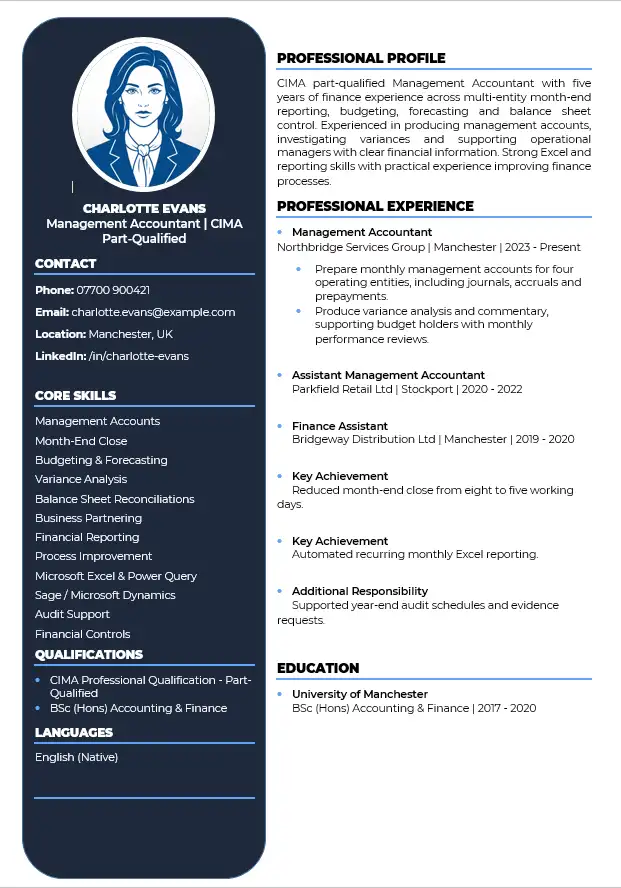
Accountant CV Example
The following accountant CV sample shows how to combine technical accounting responsibilities with commercial context and measurable improvements.
Daniel Foster
Management Accountant | CIMA Part-Qualified
Manchester, UK
07XXX XXXXXX • daniel.foster@example.com
Professional Profile
CIMA part-qualified Management Accountant with five years of finance experience across multi-entity reporting, month-end close, budgeting, forecasting and balance sheet control. Experienced in producing management accounts, investigating performance variances and supporting operational managers with financial information. Strong Excel skills with practical experience improving reporting processes and reducing manual finance work.
Professional Experience
Management Accountant
Northbridge Services Group | Manchester
January 2023–Present
- Prepare monthly management accounts for four operating entities, including journals, accruals, prepayments and balance sheet reconciliations.
- Produce monthly variance analysis and commentary for operational managers, highlighting significant movements against budget and prior periods.
- Support annual budgeting and quarterly forecasting by working with budget holders to review assumptions and expected expenditure.
- Improved the month-end timetable by redesigning reconciliation schedules and introducing clearer close responsibilities.
- Built Excel-based reporting tools that reduced manual preparation across recurring monthly reports.
- Work with non-finance managers to explain financial performance and investigate cost or margin movements.
- Support year-end audit requests and provide reconciliations and supporting documentation to external auditors.
Assistant Management Accountant
Parkfield Retail Ltd | Stockport
July 2020–December 2022
- Supported month-end close through journal preparation, accruals, prepayments and balance sheet reconciliations.
- Prepared weekly sales and margin reports and investigated significant differences with commercial teams.
- Maintained fixed-asset schedules and supported depreciation and capital-expenditure reporting.
- Assisted with VAT preparation, audit schedules and year-end finance activities.
- Helped streamline recurring Excel reports by replacing manual calculations with structured formulas and templates.
Qualifications
CIMA Professional Qualification
Part-qualified – studies in progress
BSc (Hons) Accounting and Finance
University of Manchester | 2017–2020
Accounting Systems & Tools
- Microsoft Excel
- Power Query
- Sage
- Microsoft Dynamics
- Power BI – reporting exposure
Do Not Turn Your Accountant CV Into a Job Description
Accounting responsibilities matter, but repeating a standard job description does not tell the recruiter how effectively you performed them.
Too General
Responsible for month-end reporting and balance sheet reconciliations.
More Useful
Produced monthly management accounts for four entities and redesigned reconciliation schedules to support a faster and more controlled month-end close.
The second version shows scope and contribution while remaining credible.
Quantify Accounting Achievements When the Numbers Are Real
Finance is one of the easiest professions in which to add useful numerical context, but that does not mean every bullet needs a percentage.
Useful measures may include:
- number of entities;
- business or division turnover;
- budget size;
- ledger size;
- number of accounts reconciled;
- month-end close time;
- cost savings;
- cash released;
- debtor-day improvement;
- reporting turnaround;
- process time saved;
- number of people managed or supported.
Only use figures you can explain and defend. Do not invent savings, accuracy percentages or financial outcomes simply because quantified CV bullets sound stronger.
Example
Reduced the month-end close from eight working days to five by redesigning reconciliation ownership and automating recurring reporting schedules.
Show the Scale of the Finance Environment
A job title alone rarely explains the scale of your accounting experience.
Useful context can include:
- company industry;
- group or single-entity environment;
- turnover where appropriate;
- number of entities;
- international or UK-only operations;
- finance-team size;
- reporting audience;
- ownership of a full or partial month-end process.
For example:
Produced monthly reporting for a four-entity UK services group and provided variance commentary to operational directors.
This gives the recruiter much more context than “prepared monthly reports”.
Month-End Experience: Show Your Level of Ownership
“Month-end” appears on many accounting CVs, but the phrase can describe very different levels of responsibility.
Clarify whether you:
- prepared journals;
- calculated accruals and prepayments;
- completed balance sheet reconciliations;
- owned specific P&L areas;
- produced complete management accounts;
- reviewed work prepared by others;
- investigated variances;
- prepared commentary;
- coordinated a close timetable;
- presented results to stakeholders.
This distinction is particularly important when moving from Assistant Accountant to Management Accountant or from Management Accountant to a more senior finance role.
Balance Sheet Reconciliations: Add Context
Balance sheet reconciliation is a common accounting responsibility, so it becomes more useful when you explain scope or ownership.
Basic Version
Completed balance sheet reconciliations.
Stronger Version
Prepared and reviewed monthly balance sheet reconciliations across bank, accrual, prepayment, fixed-asset and intercompany accounts, investigating aged or unexplained differences before close.
Budgeting and Forecasting: Show Your Actual Contribution
Do not claim that you “managed the budget” if your role was to collect data or update a model.
Depending on your level, you might accurately describe experience such as:
- collecting budget assumptions;
- preparing budget templates;
- challenging or reviewing submissions;
- consolidating departmental budgets;
- updating rolling forecasts;
- performing scenario analysis;
- preparing variance reports;
- working with budget holders;
- presenting forecast changes.
The wording should reflect what you personally did rather than the responsibility of the wider finance team.
Business Partnering Is More Than Attending Meetings
If you describe yourself as a business partner, show what that relationship involved.
Examples might include:
- explaining monthly performance to non-finance managers;
- challenging budget assumptions;
- supporting commercial decisions with financial analysis;
- investigating margin or cost movements;
- providing scenario analysis;
- helping operational teams understand financial KPIs;
- supporting investment or pricing decisions.
“Business partnering” becomes much stronger when the CV shows who you worked with and what decisions your analysis supported.
Accounting Software: Name Systems You Have Actually Used
Accounting systems can be important search terms for recruiters, particularly when the vacancy specifies a particular platform.
Depending on your background, examples might include:
- Sage;
- Xero;
- QuickBooks;
- SAP;
- Oracle;
- NetSuite;
- Microsoft Dynamics;
- Workday;
- Excel;
- Power Query;
- Power BI.
Do not list a system because you watched a tutorial or used it briefly once. Distinguish between daily operational use, reporting exposure and basic familiarity where necessary.
Excel Skills for an Accountant CV
Simply writing “Advanced Excel” is difficult for a recruiter to interpret because candidates use the phrase very differently.
It is often more useful to name the functions or type of work you actually perform, for example:
- PivotTables;
- XLOOKUP or INDEX/MATCH;
- SUMIFS;
- Power Query;
- financial modelling;
- variance-analysis templates;
- data reconciliation;
- report automation;
- large-data manipulation.
If Excel improvements saved time or reduced manual work, show that outcome in your employment history rather than leaving Excel as an isolated skill.
ACCA, CIMA and ACA: Write Your Qualification Status Accurately
Professional accountancy qualifications can materially affect how a recruiter interprets your level, so the status must be accurate.
Depending on your genuine position, wording might include:
- ACCA student — if you are currently studying;
- ACCA affiliate — where that is your official status;
- ACCA member — where membership has been awarded;
- CIMA / CGMA Professional Qualification – studies in progress;
- CIMA part-qualified — where this accurately reflects the stage requested by employers and your study progress;
- ACA trainee — if you are completing ACA training;
- ACA — only when you are entitled to use the designation.
Do not add professional letters after your name until you are entitled to use them. If useful, include completed examination stages, expected completion or the year in which membership was achieved.
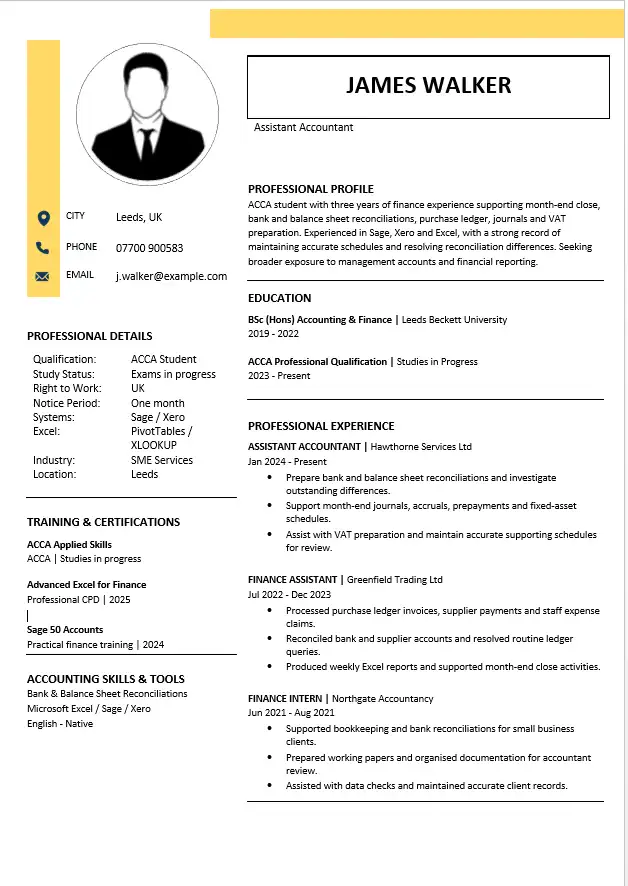
Assistant Accountant CV Example
An Assistant Accountant CV should show the finance work you can already complete reliably while making your progression clear.
Relevant experience may include:
- bank reconciliations;
- purchase and sales ledger;
- journal preparation;
- accruals and prepayments;
- fixed assets;
- intercompany reconciliations;
- VAT preparation support;
- month-end schedules;
- audit support;
- Excel reporting;
- accounting-system experience.
Assistant Accountant Profile Example
ACCA student with three years of finance experience supporting month-end close, bank and balance sheet reconciliations, purchase ledger, journals and VAT preparation. Experienced in Sage and Excel and now seeking an Assistant Accountant position offering broader exposure to management accounts and financial reporting.
Management Accountant CV Example
A Management Accountant CV should move beyond transaction processing and demonstrate management reporting, analysis and support for decision-making.
Depending on the vacancy, relevant evidence may include:
- monthly management accounts;
- full or partial P&L ownership;
- balance sheet review;
- budgeting;
- forecasting;
- variance analysis;
- KPI reporting;
- cost analysis;
- business partnering;
- financial modelling;
- process improvement;
- management reporting packs.
Management Accountant Profile Example
CIMA part-qualified Management Accountant with five years of finance experience and responsibility for monthly reporting across four operating entities. Experienced in budgeting, forecasting, variance analysis, balance sheet control and business partnering, with a track record of improving month-end processes and automating recurring Excel reports.
Financial Accountant CV Example
A Financial Accountant CV usually needs a different emphasis from a Management Accountant CV.
Depending on the position, relevant areas may include:
- statutory financial statements;
- year-end close;
- audit management or audit support;
- technical accounting;
- IFRS or UK GAAP exposure where applicable;
- balance sheet control;
- group reporting;
- consolidation;
- financial controls;
- tax or VAT liaison;
- intercompany accounting;
- reporting deadlines.
Financial Accountant Profile Example
ACA-qualified Financial Accountant with six years of experience in year-end reporting, statutory accounts preparation, audit coordination and balance sheet control within multi-entity businesses. Experienced in group reporting, financial controls and working with external auditors to deliver accurate reporting to agreed deadlines.
Qualified and Chartered Accountant CV
Once you are professionally qualified, the qualification should be easy to find, but it should not replace evidence of what you have actually delivered.
A qualified accountant CV should still make clear:
- your post-qualified experience;
- technical or commercial specialism;
- industry experience;
- level of ownership;
- team or stakeholder responsibility;
- scale of reporting;
- major improvements or achievements;
- systems and transformation experience.
For ICAEW Chartered Accountants, including the year in which ACA membership was achieved can help the recruiter understand your qualification timeline.
Senior Accountant CV: Show Ownership, Not Just More Duties
A senior title should be supported by evidence of greater ownership.
This might include:
- reviewing work prepared by junior staff;
- owning reporting deadlines;
- leading month-end activities;
- reviewing balance sheet reconciliations;
- managing audit requests;
- improving controls;
- training colleagues;
- business partnering with senior stakeholders;
- leading process or systems improvements.
The CV should make the increase in accountability visible rather than simply adding “Senior” to the job title.
What Skills Should an Accountant CV Include?
The best accounting skills depend on the vacancy and your level.
Potentially relevant skills include:
- management accounts;
- financial reporting;
- month-end close;
- balance sheet reconciliations;
- budgeting and forecasting;
- variance analysis;
- cash-flow reporting;
- working-capital analysis;
- statutory reporting;
- audit support;
- financial controls;
- VAT;
- fixed assets;
- business partnering;
- financial modelling;
- Excel;
- ERP or accounting systems;
- process improvement;
- stakeholder communication.
Do not rely on the skills section alone. Your strongest technical skills should also appear naturally in your employment evidence.
Technical Skills Are Not Enough on Their Own
Accounting roles also require communication, judgement and the ability to work with people outside finance.
Rather than listing “communication” or “problem solving”, demonstrate these qualities through examples such as:
- explaining financial results to non-finance managers;
- challenging unusual expenditure;
- working with operational teams during budget preparation;
- resolving reconciliation differences;
- coordinating information for auditors;
- training colleagues on reporting processes;
- improving controls after identifying recurring errors.
How to Tailor an Accountant CV to the Job Description
Management Accountant, Financial Accountant, Assistant Accountant and Senior Accountant roles can use similar terminology but prioritise different experience.
If a vacancy focuses heavily on:
- budgeting;
- forecasting;
- variance analysis;
- business partnering;
then those areas should receive more attention when they genuinely match your experience.
If another vacancy focuses on:
- statutory reporting;
- audit;
- IFRS;
- group reporting;
- financial controls;
the same CV should be rebalanced toward that evidence.
Tailoring does not mean copying the advert. It means making the most relevant evidence from your own career easier to find.
Accountant CV Template: Word or PDF?
Microsoft Word is useful while you are updating and tailoring an accountant CV because the DOCX remains editable.
PDF is useful when the employer requests or accepts it and you want to preserve the final document layout.
A practical workflow is:
- Keep an editable master CV in Word.
- Tailor it to the accounting vacancy.
- Check dates, qualifications, figures and formatting.
- Save a separate application copy.
- Export to PDF when the application instructions call for PDF.
- Open the PDF and check that tables, dates, bullet points and page breaks have not moved.
Free Accountant CV Templates in Word Format
The accountant CV examples on WordCV are designed to be editable in Microsoft Word. Choose the version that most closely reflects your accounting level and then replace every sample detail with your own experience.
- Assistant Accountant CV — for transactional finance, reconciliations, month-end support and developing accounting experience;
- Management Accountant CV — for management accounts, budgeting, forecasting, variance analysis and business partnering;
- Financial Accountant CV — for statutory reporting, audit, financial controls and year-end accounting.
A sample CV for an accountant in Word format should be treated as a starting point, not as finished application text. Replace all example figures, qualifications, systems and achievements with information you can genuinely support.
Common Accountant CV Mistakes
- Listing responsibilities without impact. Show what changed, improved or was delivered.
- Hiding qualification status. Make ACCA, CIMA, ACA or other relevant status clear and accurate.
- Using a generic summary. State your accounting level and specialism.
- Writing only “month-end”. Explain your level of ownership.
- Listing “Excel” with no context. Show how you actually use it.
- Claiming advanced software knowledge after minimal exposure. Describe your real level.
- Using the same CV for Management Accountant and Financial Accountant roles. Rebalance the evidence to the vacancy.
- Inventing financial achievements. Only use figures you can explain.
- Hiding your best achievements on page two. Prioritise the most relevant evidence.
- Filling the CV with accounting jargon. Clear evidence is more useful than terminology alone.
Accountant CV Final Checklist
- Is your accounting level immediately clear?
- Is your professional qualification status accurate?
- Does your profile identify your accounting specialism?
- Have you shown the scale of your finance environment?
- Is month-end ownership explained clearly?
- Have you shown relevant reconciliations and controls?
- Are budgeting and forecasting responsibilities accurately described?
- Have you shown business partnering where relevant?
- Are accounting systems and Excel skills specific?
- Have you included measurable results where reliable figures exist?
- Does recent experience receive more detail than older experience?
- Have you tailored the CV to the exact accounting role?
- Are every figure and achievement defensible at interview?
- Have you checked spelling, dates and financial terminology?
If you need help with the overall structure as well as the finance-specific details, our CV writing guide covers how to write a clear profile, organise work experience and choose relevant skills.
Need an Editable Accountant CV Template?
Start with an editable Microsoft Word CV and replace the example content with your own accounting experience, qualifications, systems and measurable achievements.
Accountant CV FAQs
How should I write a CV as an accountant?
Start by identifying your accounting level, professional qualification status and strongest relevant experience. Use reverse chronological work history and show the scope of your responsibilities, such as entities, reporting, month-end, reconciliations, budgeting, audit or financial controls. Include achievements and measurable improvements where reliable evidence exists.
What is a good summary for an accountant’s CV?
A good accountant CV summary identifies what type of accountant you are, your qualification stage, your level of experience and the accounting work most relevant to the target role. Avoid generic phrases such as hardworking, motivated or results-driven unless the rest of the CV provides evidence.
What are the skills of an accountant in a CV?
Relevant skills can include management accounts, month-end close, balance sheet reconciliations, budgeting, forecasting, variance analysis, financial reporting, audit support, financial controls, VAT, business partnering, Excel and accounting systems. The right selection depends on the vacancy and your actual experience.
How do I write a strong accountant CV?
Make the CV easy to scan, tailor it to the accounting role and focus on evidence rather than generic responsibilities. Show ownership, scale and outcomes. For example, explain how many entities you supported, what part of month-end you owned, how reporting improved or where a process became faster or more accurate.
Should I include ACCA, CIMA or ACA on my CV?
Yes, when relevant. State your exact current status accurately. If you are studying, say so. If you are qualified and entitled to use professional designatory letters, make the qualification easy to find. Do not present yourself as a member or chartered accountant before you hold the required status.
Should an accountant CV include Excel?
Yes when Excel is relevant to the role, but be more specific than simply writing “Advanced Excel”. Mention the functions, reporting processes or automation you genuinely use, such as PivotTables, XLOOKUP, Power Query, reconciliation models or financial reporting templates.
What is the difference between a Management Accountant and Financial Accountant CV?
A Management Accountant CV usually places more emphasis on management accounts, budgeting, forecasting, variance analysis, KPIs and business partnering. A Financial Accountant CV commonly places greater emphasis on statutory reporting, audit, year-end, technical accounting, balance sheet control and financial reporting standards. The exact distinction depends on the employer.
Should an accountant CV be in Word or PDF?
Keep an editable Word version for tailoring. Submit DOCX or PDF according to the employer’s instructions. If you export the CV to PDF, open the final file and check that dates, tables, bullet points and page breaks still display correctly.
How long should an accountant CV be?
Use enough space to show relevant accounting experience clearly without adding filler. An early-career accountant may fit comfortably on one page, while an experienced or qualified accountant may need two pages. Relevant evidence is more important than forcing the document to an arbitrary length.
Explore More CV Examples
Teacher CV Example
See how to present curriculum experience, teaching responsibilities, qualifications and school-specific evidence.
Nurse CV Example
See registered, student and newly qualified nurse CV examples for UK healthcare roles.