

TEACHER CV EXAMPLE & WRITING GUIDE
A strong teacher CV should show more than where you have worked. Schools need to understand what you teach, which pupils you have worked with, how you plan and assess learning, how you support progress and inclusion, and how you contribute to a safe and effective school environment.
A Teacher CV Is Not Just a List of Lessons You Delivered
Many teaching CVs describe the job rather than the teacher.
Statements such as:
Planned lessons, taught pupils and marked work.
are accurate, but they tell a school very little because these activities are expected parts of teaching.
A stronger CV helps the reader understand the context in which you taught and the contribution you made:
- subject or curriculum area;
- year groups or key stages;
- class sizes where useful;
- assessment responsibilities;
- pupil progress;
- behaviour management;
- SEND and differentiated teaching;
- pastoral responsibilities;
- safeguarding awareness;
- parent and carer communication;
- curriculum or departmental contributions;
- clubs, trips, mentoring or wider school responsibilities.
Before Writing the CV, Check How the School Wants You to Apply
Do not assume that every teaching vacancy accepts a CV.
Many UK schools and academy trusts use their own application forms because they need consistent employment histories, references, safeguarding information and responses against the job description and person specification.
If the vacancy requests an application form, complete that form rather than sending only a CV.
A teacher CV is still useful when:
- the employer specifically requests one;
- you are registering with an education recruitment agency;
- you are applying to an employer that accepts CV applications;
- you need a clear master record of your teaching career;
- you are applying internationally;
- you want a source document from which to complete school application forms.
What Should Be Obvious in the First Part of a Teacher CV?
A school should not have to read halfway through the document to work out what you teach.
Depending on your background, the first part of the CV should quickly establish:
- your teaching role or subject specialism;
- primary, secondary, special or other school experience;
- relevant key stages or year groups;
- your level of experience;
- QTS or other relevant professional status where applicable;
- important curriculum experience;
- any particularly relevant SEND, pastoral or leadership responsibility.
A generic heading such as “Experienced Teacher” is less useful than something more specific such as “Secondary English Teacher | KS3–KS4” or “Primary Teacher | Years 3–6”.
Teacher CV Profile: Be Specific About Your Classroom Experience
A profile can help when it quickly identifies your teaching background. Avoid filling it with qualities that the school cannot verify.
Weak Example
Passionate, hardworking and dedicated teacher with excellent communication skills who always puts students first.
Stronger Example
Secondary English Teacher with six years of experience teaching KS3 and KS4 pupils across mixed-ability classes. Experienced in curriculum planning, formative and summative assessment, differentiated teaching and supporting pupils with SEND, with additional responsibility for Year 9 literacy intervention.
The stronger version tells the reader what the teacher actually does and where their experience is concentrated.
Teacher CV Example
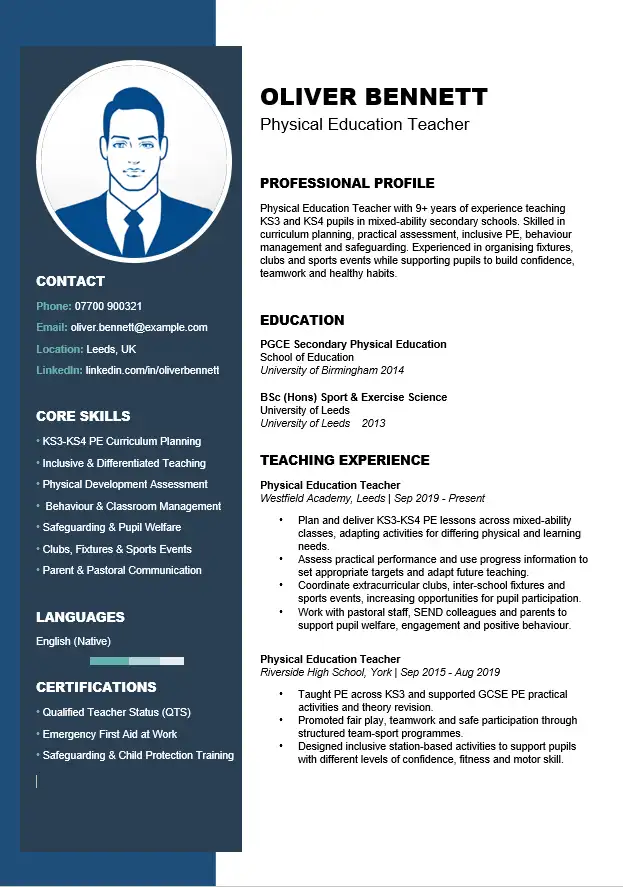
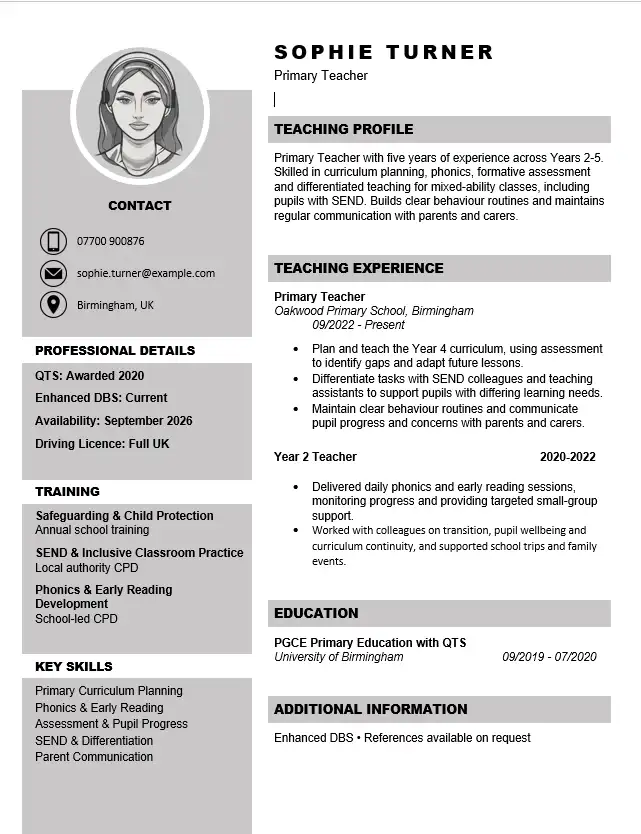
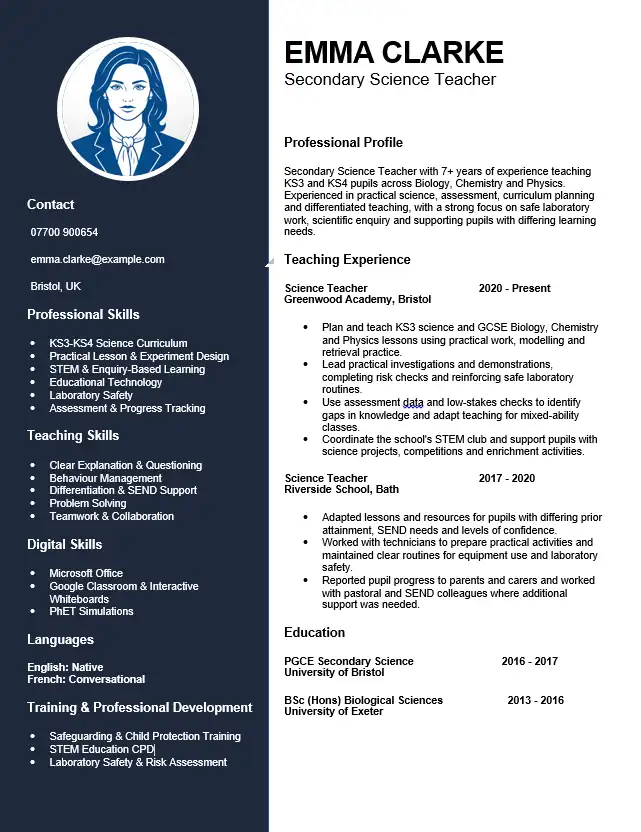
The following example shows how a secondary teacher can present classroom context, responsibilities and evidence without turning every entry into a long list of generic teaching duties.
Emily Thompson
Secondary English Teacher | KS3–KS4
Manchester, UK
07XXX XXXXXX • emily.thompson@example.com
Professional Profile
Secondary English Teacher with six years of experience teaching KS3 and KS4 pupils in mixed-ability comprehensive schools. Experienced in curriculum planning, assessment, behaviour management and differentiated teaching, with additional responsibility for literacy intervention and support for pupils with SEND.
Teaching Experience
English Teacher
Northfield Academy | Manchester
September 2021–Present
- Teach English Language and Literature across Years 7–11, adapting lessons for mixed-ability classes and individual learning needs.
- Plan schemes of work with departmental colleagues and use assessment information to identify gaps in knowledge and adjust future teaching.
- Provide targeted support for pupils requiring additional literacy intervention and work with SEND colleagues to implement appropriate classroom strategies.
- Maintain clear behaviour expectations and follow school procedures to support a safe and purposeful learning environment.
- Communicate pupil progress and concerns to parents and carers through reports, meetings and agreed school channels.
- Coordinate a Year 9 literacy intervention programme and monitor pupil participation and progress.
- Contribute to departmental standardisation, curriculum review and shared teaching resources.
English Teacher
Riverside High School | Salford
September 2019–August 2021
- Taught English across KS3 and supported GCSE classes with reading, writing and examination preparation.
- Used regular formative assessment and feedback to identify pupils requiring additional support.
- Worked with teaching assistants and pastoral colleagues to support pupils with differing academic and behavioural needs.
- Supported extracurricular reading activities and school literacy events.
Education & Professional Qualifications
PGCE Secondary English
Example University
BA (Hons) English Literature
Example University
Qualified Teacher Status (QTS)
Relevant Professional Development
- Safeguarding and child protection training
- SEND and inclusive classroom practice
- Assessment and feedback
- Behaviour management
Private School Teacher CV Example
A private school teacher CV may need to show more than classroom delivery alone. Independent schools can place additional emphasis on subject depth, pastoral contribution, extracurricular activities, parent communication and involvement in the wider life of the school.
If you are looking for a private school teacher resume sample, focus on the teaching context and evidence that matches the vacancy rather than filling the CV with generic duties.
Relevant evidence may include:
- subject or phase specialism;
- year groups and examination classes;
- small-group, extension or enrichment teaching;
- pastoral or form-tutor responsibilities;
- clubs, societies, sport or extracurricular activities;
- parent communication;
- school trips or residential activities;
- curriculum development;
- scholarship, entrance or examination preparation where relevant;
- boarding or house responsibilities if they genuinely formed part of your role.
Private School Teacher CV Profile Example
Secondary Mathematics Teacher with eight years of experience teaching KS3, GCSE and A level pupils in independent and maintained schools. Experienced in extension teaching, examination preparation, pastoral support and extracurricular mathematics activities, with a strong record of communicating pupil progress clearly to parents and colleagues.
If a private school asks for a PDF CV, edit and proofread the document in Word first and export the finished version as PDF. Keep the editable DOCX copy so you can tailor it for future vacancies.
Show Which Pupils You Have Actually Taught
“Teacher” covers very different classroom environments.
Where relevant, make the teaching context visible:
- year groups;
- key stages;
- subject;
- GCSE, A level or other examination classes;
- mixed-ability teaching;
- small-group intervention;
- pupils with SEND;
- EAL learners;
- pastoral or form responsibilities;
- specialist or alternative provision.
This helps a school judge how closely your existing experience matches its vacancy.
Curriculum Knowledge Should Be Visible, Not Assumed
Subject knowledge alone does not explain whether you can plan and deliver learning within the curriculum used by the employer.
Where genuinely relevant, your CV might refer to:
- National Curriculum experience;
- specific key stages;
- GCSE or A level specifications;
- curriculum planning;
- schemes of work;
- curriculum review;
- subject leadership;
- moderation or standardisation;
- assessment frameworks.
This is particularly important when applying from another education system. Do not simply rename overseas experience with UK terminology if it is not accurate. Instead, explain what you taught and identify any genuine experience or training that demonstrates familiarity with the curriculum required by the vacancy.
Do Not Write “Safeguarding” as an Empty Keyword
Safeguarding is a core responsibility in education. It should not appear as a decorative skill alongside phrases such as teamwork and time management.
Your CV can show relevant safeguarding awareness through accurate references to your experience, for example:
- following school safeguarding and child protection procedures;
- recording and reporting concerns through the correct channels;
- working within school policies and professional boundaries;
- completing current safeguarding training;
- supporting pupil welfare as part of pastoral responsibilities.
Do not claim responsibilities that belonged to a Designated Safeguarding Lead or another specialist role unless you actually held them.
SEND Experience Needs More Detail Than “Supported SEND Pupils”
If SEND experience matters to the vacancy, explain what that support involved.
Useful context may include:
- differentiating classroom tasks;
- working with teaching assistants or SEND staff;
- adapting resources;
- supporting pupils with individual learning needs;
- using agreed classroom strategies;
- monitoring progress;
- supporting inclusion in whole-class learning.
Too Vague
Supported SEND students.
More Useful
Adapted lesson resources and worked with SEND colleagues and teaching assistants to support pupils with differing literacy and communication needs in mixed-ability classes.
Assessment Is Part of the Teaching Story
Assessment should not be reduced to “marked pupils’ work”.
Depending on the role, relevant evidence may include:
- formative assessment;
- summative assessment;
- tracking pupil progress;
- identifying gaps in knowledge;
- using assessment to adapt teaching;
- moderation or standardisation;
- exam preparation;
- providing written and verbal feedback;
- reporting progress to parents and carers.
This shows that assessment informs your teaching rather than existing as a separate administrative task.
Show Pupil Progress Carefully
Teaching CV advice often recommends adding numbers to every achievement. In education, that needs more care.
Use measurable outcomes when you genuinely have reliable evidence, but do not invent percentages or imply that a complex pupil outcome resulted from your work alone.
Possible Evidence
- progress against an agreed intervention target;
- improvement in assessment outcomes;
- participation in a literacy or numeracy programme;
- successful curriculum or departmental initiatives;
- improved completion or engagement where records support it;
- exam results when you can accurately describe the context.
Evidence does not always need to be numerical. A clear description of a curriculum initiative, intervention or additional responsibility can still demonstrate impact.
Behaviour Management: Replace the Label With the Practice
“Strong classroom management” is a common CV phrase, but it does not explain your approach.
Depending on your experience, you could show:
- clear classroom routines and expectations;
- consistent use of the school’s behaviour policy;
- positive reinforcement;
- support for pupils with behavioural or emotional needs;
- collaboration with pastoral teams;
- communication with parents or carers;
- restorative or other school-approved approaches where applicable.
Use language that accurately reflects the policies and strategies you have actually worked with.
Do Not Forget the Work You Do Outside the Lesson
Teaching is broader than classroom delivery. Additional responsibilities can distinguish two candidates with similar timetables.
Relevant examples may include:
- form tutor responsibilities;
- pastoral work;
- subject or phase leadership;
- mentoring trainee or early-career teachers;
- supporting teaching assistants;
- curriculum development;
- clubs and extracurricular activities;
- school trips;
- parent events;
- transition work;
- literacy or numeracy interventions;
- school improvement initiatives;
- professional development delivered to colleagues.
Do not add every club you have ever supervised. Prioritise responsibilities that reveal useful teaching, leadership or pastoral experience.
QTS, PGCE and Teaching Qualifications: Keep Them Clear
If you hold Qualified Teacher Status, make it easy to find where it is relevant to the role.
Do not treat QTS and PGCE as interchangeable. QTS is professional teaching status in England, while a PGCE is an academic qualification that may accompany teacher training.
Depending on your circumstances, your qualifications section might contain:
- Qualified Teacher Status (QTS);
- PGCE or other teacher training qualification;
- degree and subject;
- relevant specialist qualifications;
- current professional development.
If you trained outside England, check the current official requirements for the type of school and role you are targeting rather than assuming your overseas qualification has exactly the same status.
Overseas-Trained Teacher? Translate the Context, Not Your Career
An overseas teaching career can be highly relevant, but the reader may not automatically understand your school system, qualification level or curriculum.
Help them by making the context clear:
- age range taught;
- subject;
- curriculum or examination system;
- classroom responsibilities;
- assessment approach;
- safeguarding or child-protection training relevant to your actual experience;
- any genuine familiarity with the English education system;
- QTS status or application where relevant and accurate.
Avoid changing job titles or responsibilities simply to make them sound British. Clear explanation is more credible than forced terminology.
Primary and Secondary Teacher CVs Should Not Read the Same
Primary Teacher
Relevant evidence may include:
- year group;
- teaching across the primary curriculum;
- phonics;
- literacy and numeracy;
- pupil progress;
- classroom environment;
- SEND support;
- parent communication;
- subject leadership.
Secondary Teacher
Relevant evidence may include:
- subject specialism;
- key stages;
- exam classes;
- curriculum specifications;
- assessment and moderation;
- intervention;
- departmental contributions;
- form or pastoral responsibilities.
The same general CV structure can work for both, but the evidence should reflect the actual teaching environment.
New Teacher and Student Teacher CV Example
A new teacher CV should not try to imitate the career history of an experienced teacher. If you are completing teacher training or applying for your first teaching position, use the evidence you already have from placements, training, classroom observations, subject knowledge and relevant previous work.
A student teacher CV example can include:
- PGCE, SCITT or another teacher-training programme;
- QTS status or expected completion where accurate;
- school placements;
- year groups or key stages taught;
- subjects or curriculum areas;
- lesson planning;
- assessment and feedback;
- behaviour management experience;
- SEND and differentiated teaching;
- safeguarding training;
- extracurricular or pastoral contributions;
- relevant employment before teacher training.
New Teacher CV Profile Example
Early-career Primary Teacher completing a PGCE with QTS, with school-placement experience across Years 2 and 4. Experienced in lesson planning, phonics, formative assessment, positive behaviour routines and adapting classroom activities for pupils with different learning needs.
Do not describe yourself as having several years of teaching experience if most of that time was training or placement-based. Make your career stage clear and use specific classroom evidence to show what you can already do.
Teacher CV Skills: Avoid a Generic List
A long list containing “communication, teamwork, organisation, leadership and time management” adds little if the employment section already demonstrates those qualities.
Prioritise skills with direct relevance to teaching, for example:
- curriculum planning;
- assessment;
- differentiation;
- SEND and inclusive practice;
- behaviour management;
- pastoral support;
- subject knowledge;
- data or pupil-progress tracking;
- educational technology;
- parent communication;
- curriculum leadership where applicable.
Then use your work experience to prove the most important ones.
Teacher CV Mistakes That Hide Good Experience
- Listing only duties. Explain classroom context and contribution.
- Not naming year groups or key stages. Make your teaching experience easier to compare with the vacancy.
- Using a generic profile. Replace personality claims with actual teaching context.
- Treating safeguarding as a buzzword. Describe relevant awareness and training accurately.
- Writing “SEND experience” with no explanation. Show what support involved.
- Hiding curriculum experience. Make genuine curriculum knowledge visible.
- Quantifying everything. Only use numbers that are accurate and meaningful.
- Ignoring wider-school responsibilities. Pastoral, curriculum and extracurricular contributions may matter.
- Using one CV for every teaching vacancy. Different schools and roles prioritise different evidence.
- Sending a CV when the school asks for an application form. Always follow the vacancy instructions.
How to Tailor a Teacher CV to a Vacancy
Read both the job description and person specification before editing the CV.
For example, if a vacancy repeatedly refers to:
- KS3 and KS4 teaching;
- raising literacy;
- SEND inclusion;
- strong behaviour routines;
- form tutor responsibility;
and those genuinely match your experience, they should be easier to find than unrelated information from older roles.
Do not simply copy phrases from the advert. Connect the requirement to evidence from your own work.
How Long Should a Teacher CV Be?
Use enough space to present relevant teaching evidence clearly rather than aiming for an arbitrary length.
An early-career teacher may fit comfortably on one page. An experienced teacher with several relevant posts, curriculum responsibility, leadership or professional development may need two.
Do not make the font unnecessarily small to protect a one-page format, and do not add weak information simply to fill page two.
Compare our one-page CV template and two-page CV template if you need help choosing a structure.
Teacher CV Final Checklist
- Is your teaching specialism immediately clear?
- Have you identified relevant year groups or key stages?
- Is curriculum experience visible?
- Does work experience include more than generic teaching duties?
- Have you shown assessment and pupil-progress responsibilities?
- Is SEND experience explained rather than simply listed?
- Have you represented safeguarding responsibilities accurately?
- Is behaviour management demonstrated through practice?
- Have you included relevant pastoral or wider-school responsibilities?
- Are QTS and qualifications clear where applicable?
- Have you prioritised recent and relevant teaching experience?
- Does the CV match the vacancy rather than every teaching job?
- Have you followed the employer’s application instructions?
Free Teacher CV Templates in Word Format
If you need a free teacher resume template to edit, the examples on this page are available as Microsoft Word documents. In UK applications, CV is normally the more common term, but people searching for a teacher resume often want the same thing: an editable document they can tailor to a teaching vacancy.
You can download three completed examples from the Teacher CV Example section above:
- Physical Education Teacher CV — for PE, sport and physical education roles;
- Primary Teacher CV — a primary school teacher CV in Word format with curriculum planning, phonics, SEND, assessment and parent communication;
- Secondary Science Teacher CV — for KS3-KS4 science roles with practical science, STEM, assessment and laboratory-safety experience.
Each Word document is a starting point rather than a finished application. Replace the example profile, experience, skills and qualifications with evidence from your own teaching career, then tailor the wording to the job description and person specification.
If you need a sample CV for teachers in Word format, begin with the example that most closely matches your teaching environment rather than choosing only by visual style.
Need a Word Template for Your Teacher CV?
Choose an editable Microsoft Word CV template and replace the example content with your own teaching experience, qualifications and achievements.
Teacher CV FAQs
Do UK schools accept CVs for teaching jobs?
Some do, but many schools and academy trusts use their own application forms. Always follow the instructions in the vacancy rather than assuming a CV is sufficient.
Should I put QTS on my teacher CV?
If you hold QTS and it is relevant to the position, make it easy to find. QTS is required for teaching in many schools in England and is preferred by many others.
Should I include safeguarding on my CV?
Safeguarding awareness and current training are relevant to school roles, but avoid treating safeguarding as a generic skill. Describe your experience and responsibilities accurately and follow current school and statutory guidance.
Should I include pupil results?
You can include reliable and meaningful evidence of pupil progress or outcomes where appropriate. Avoid inventing statistics or claiming sole responsibility for outcomes influenced by many factors.
What skills should a teacher CV include?
Relevant skills may include curriculum planning, assessment, differentiation, SEND and inclusive practice, behaviour management, pastoral support, educational technology and subject knowledge. Prioritise the skills requested by the vacancy and support them with evidence from your teaching experience.
Should a teacher CV include a photo?
For typical UK school applications, a photograph is generally unnecessary. Focus the document on qualifications, teaching experience and evidence relevant to the role unless the employer specifically requests something different.
Can an overseas-trained teacher use this CV structure?
Yes. Make your teaching context clear, including age ranges, subjects, curriculum experience and qualifications. Check current QTS and employment requirements for England if that is where you intend to teach.
Explore More CV Examples
Nurse CV Example
How to present clinical experience, registration, patient care and professional responsibilities.
Coming next
Accountant CV Example
How to present accounting responsibilities, systems, qualifications and financial achievements.
Coming soon