
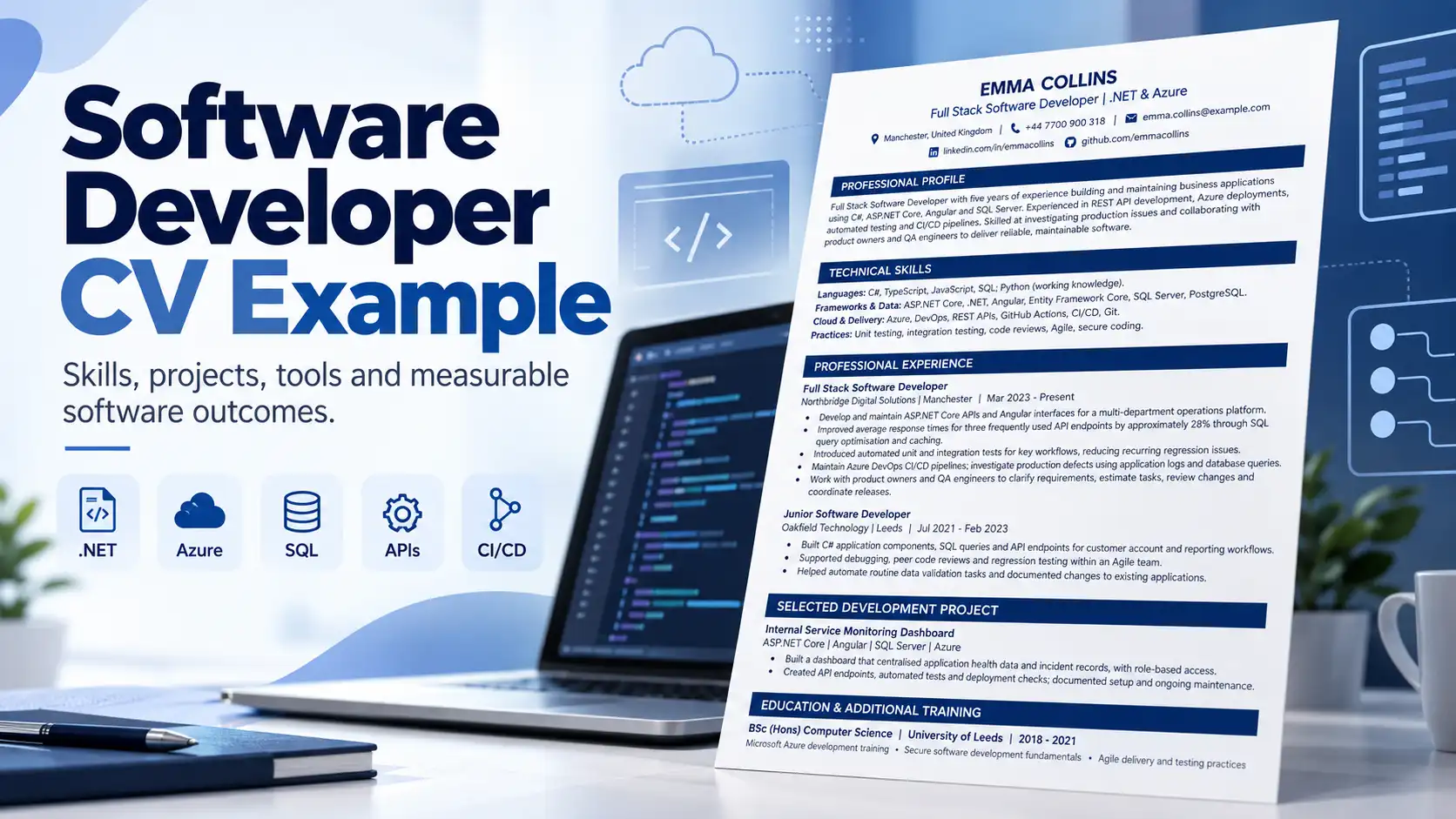

A software developer’s CV should make one thing clear: what can you actually build, maintain and improve? A list of programming languages is useful, but it tells an employer very little about how you approach technical problems, work with existing code or deliver software that people depend on.
This Software Developer CV example shows how to present programming skills, professional experience, technical projects, development tools and measurable achievements without turning your CV into a long technology inventory. You can also download a free, editable Microsoft Word template and adapt it to your own specialism.
Software Developer CV Example
Our completed example follows a full stack developer with five years of professional experience, primarily working with C#, .NET, Angular and Microsoft Azure. It demonstrates how to describe development work alongside testing, deployment, troubleshooting and collaboration.
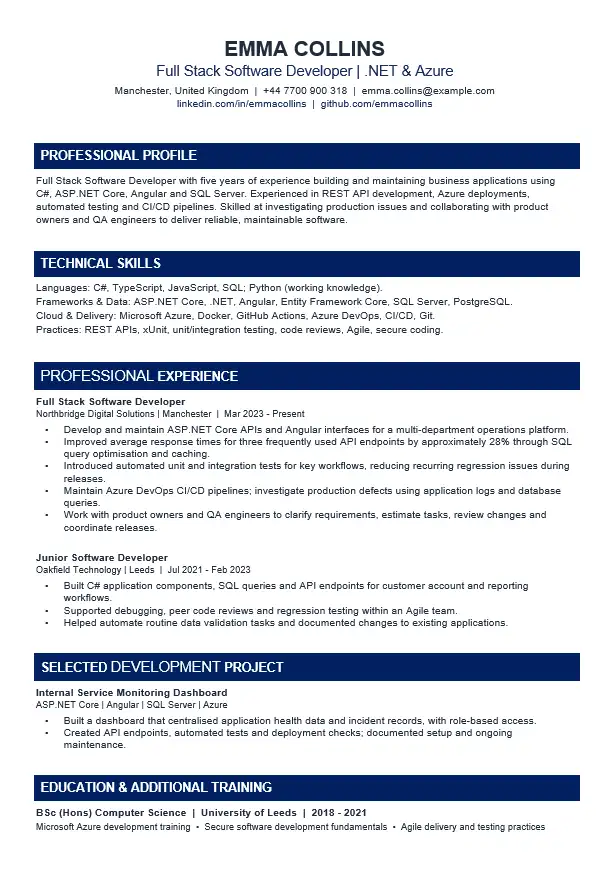
The template is editable in Microsoft Word. Replace the sample details with your own technical stack, employment history and projects. Only include technologies you have genuinely used and achievements you can explain during an interview.
A Completed Software Developer CV Sample
The following sample provides the written content behind the downloadable example. Names, companies and achievements are illustrative.
Emma Collins
Full Stack Software Developer | .NET & Azure
Manchester, United Kingdom
+44 7700 900 318 | emma.collins@example.com
linkedin.com/in/emmacollins | github.com/emmacollins
Professional Profile
Full Stack Software Developer with five years of experience building and maintaining business applications using C#, ASP.NET Core, Angular and SQL Server. Experienced in REST API development, Azure deployments, automated testing and CI/CD pipelines. Comfortable investigating production issues, improving existing systems and working with product owners and QA engineers to deliver reliable, maintainable software.
Technical Skills
- Languages: C#, TypeScript, JavaScript, SQL, Python (working knowledge).
- Frameworks: ASP.NET Core, .NET, Angular, Entity Framework Core.
- Cloud & DevOps: Microsoft Azure, Docker, GitHub Actions, Azure DevOps.
- Databases: SQL Server, PostgreSQL.
- Development & Testing: REST APIs, Git, xUnit, integration testing, CI/CD, code reviews.
- Working Practices: Agile delivery, technical documentation, troubleshooting and secure coding.
Professional Experience
Full Stack Software Developer
Northbridge Digital Solutions | Manchester
March 2023 – Present
- Develop and maintain ASP.NET Core APIs and Angular interfaces for an internal operations platform used across multiple departments.
- Improved average response times for three frequently used API endpoints by approximately 28% through query optimisation and caching.
- Introduced automated unit and integration tests for key business workflows, reducing recurring regression issues during releases.
- Maintain CI/CD pipelines in Azure DevOps, supporting consistent build, test and deployment processes.
- Investigate production defects using application logs and database queries, document root causes and coordinate fixes with QA and support teams.
- Work with product owners to clarify requirements, estimate development tasks and review changes before release.
Junior Software Developer
Oakfield Technology | Leeds
July 2021 – February 2023
- Built and updated C# application components supporting customer account management and reporting workflows.
- Created and maintained SQL queries, API endpoints and technical documentation for existing applications.
- Assisted with debugging, peer code reviews and regression testing within an Agile development team.
- Helped automate routine data validation tasks, reducing the time spent on manual checks.
Selected Development Project
Internal Service Monitoring Dashboard
ASP.NET Core | Angular | SQL Server | Azure
- Developed a dashboard to centralise application health information and service incident records.
- Created API endpoints for collecting and presenting monitoring data, with role-based access to operational information.
- Added automated tests and deployment checks to support ongoing development and maintenance.
Education
BSc (Hons) Computer Science
University of Leeds | 2018 – 2021
Additional Training
- Microsoft Azure development training
- Secure software development fundamentals
- Agile software delivery and testing practices
What Should a Software Developer CV Actually Demonstrate?
Two developers may both list C#, SQL and Azure, yet have very different experience. One might have spent most of their time maintaining existing applications and resolving production incidents. The other may have designed new services, managed deployments and taken responsibility for technical decisions.
Neither background should be reduced to a list of programming languages. Your CV needs to explain the work behind the technology. When choosing what to include, consider these questions:
- What applications, APIs, services or features have you developed?
- Which parts of the system were you personally responsible for?
- What technical problems have you investigated or resolved?
- How do you test your code and contribute to software quality?
- Have you worked with databases, cloud services or deployment pipelines?
- How do you collaborate with developers, testers, analysts or stakeholders?
- What became faster, more reliable, more secure or easier to maintain because of your contribution?
You do not need an extraordinary project to demonstrate useful experience. Improving an existing API, fixing a difficult defect or replacing a repetitive manual process with a reliable automated workflow can be worth including when you explain its practical value.
How to Write a Software Developer CV
A good software developer CV format allows someone to identify your specialism, technical stack and relevant experience without searching through several paragraphs. The sections below provide a practical structure for most professional software development applications.
1. Start with Your Name, Role and Relevant Links
Include your name, location, professional email address and contact number. Your LinkedIn profile, GitHub account or portfolio can also be useful, provided the information is relevant and reasonably up to date. Use a job title that accurately reflects your experience, such as:
- Software Developer
- Junior Software Developer
- Full Stack Developer (.NET & Angular)
- Backend Software Engineer
- Cloud & Data Developer
There is no need to force every technology into the title. A focused title helps employers understand your main area of work; the technical skills section can provide the details.
2. Write a Profile That Explains Your Development Background
A software developer CV profile should be specific enough to distinguish your experience from that of other applicants. Mention your specialism, relevant technologies and the kind of systems or products you have worked on.
Experienced developer profile example:
Software Developer with five years of experience developing and maintaining .NET applications and cloud-based services. Skilled in C#, ASP.NET Core, SQL Server and Azure, with hands-on experience in API development, automated testing, CI/CD and production troubleshooting. Comfortable taking ownership of development tasks and collaborating with cross-functional teams.
Junior developer profile example:
Junior Software Developer with practical experience building web applications using JavaScript, TypeScript and React. Familiar with REST APIs, Git, SQL and automated testing through academic and independent projects. Looking to contribute to a collaborative development team while building experience in production software delivery.
Choose a profile that matches your actual background. Someone with mainly frontend experience should not describe themselves as an experienced cloud architect simply because those terms appear in a vacancy.
3. Organise Technical Skills by Category
A technical skills section should help someone locate the technologies that matter for the position. Grouping them is usually more readable than placing every programming language, library, service and development tool in one long sentence.
| Category | Examples of relevant skills |
|---|---|
| Programming languages | C#, Python, Java, JavaScript, TypeScript, SQL |
| Frameworks & libraries | ASP.NET Core, .NET, Angular, React, Node.js |
| APIs & architecture | REST APIs, microservices, event-driven systems, event sourcing |
| Databases | SQL Server, PostgreSQL, MongoDB, InfluxDB |
| Cloud & deployment | Microsoft Azure, AWS, Docker, Kubernetes |
| Testing | xUnit, Jasmine, integration testing, end-to-end testing |
| Development workflow | Git, GitHub Actions, Jenkins, Azure DevOps, CI/CD |
| Security & quality | OWASP practices, authentication, code reviews, technical documentation |
This is a selection of possible skills, not a checklist of everything a software developer must know. Include the tools you have actually worked with, and prioritise those relevant to the job. If a technology is only familiar to you through introductory coursework, avoid presenting it as professional expertise.
4. Describe Development Experience, Not Just Responsibilities
Software development is rarely limited to writing new code. Existing applications need maintenance, unfamiliar defects need investigation, releases require testing and deployment processes must remain dependable.
Your experience section can therefore cover a range of responsibilities, including feature development, technical design, API integration, database work, application support, code reviews, automated testing and delivery.
The important detail is explaining your contribution. Consider the difference between these examples:
| Too general | More useful CV wording |
|---|---|
| Worked on APIs. | Developed and maintained REST API endpoints in ASP.NET Core to support customer account and reporting features. |
| Fixed software bugs. | Investigated recurring production errors using application logs and SQL queries, then implemented and tested corrective changes. |
| Used Azure DevOps. | Maintained build and deployment pipelines in Azure DevOps, incorporating automated tests before release. |
| Worked with the team. | Collaborated with developers, QA engineers and product owners to clarify requirements, review code and resolve release issues. |
| Responsible for testing. | Created xUnit tests for critical business logic and supported integration testing of API and database changes. |
You do not have to use every example. Select the responsibilities that genuinely represent your experience and make the most relevant ones easy to find.
5. Show the Result of Your Code
Measurable achievements are especially useful when your work has improved software performance, reliability, delivery speed or operational efficiency. For example, rather than writing only “Optimised database queries”, you could explain which process was affected and what changed:
Optimised SQL queries and introduced caching for frequently accessed API endpoints, reducing average response times by 28% during performance testing.
Other useful evidence may include reduced processing time, fewer recurring defects, lower cloud resource usage, faster deployment cycles or the removal of repetitive manual work. What if you do not have exact figures? Do not invent them. Describe the practical outcome instead: for example, simplifying a deployment process, improving error handling or making a component easier to maintain. A clear and credible result is better than an unsupported percentage.
If your next move is towards reporting, business intelligence or analytics rather than software development, our Data Analyst CV example shows how to present SQL, Power BI, Excel and data projects in a focused CV.
How to Present Software Development Projects on Your CV
A project becomes useful CV evidence when it explains more than its title and technology stack. Consider a developer who has created a service monitoring dashboard. Writing “Monitoring Dashboard – C#, Angular, Azure” identifies the tools, but leaves important questions unanswered: Why was it built? What did the developer implement? Was it tested? How was it deployed? A stronger description might look like this:
Software Project CV Example
Service Monitoring Dashboard
Technologies: C#, ASP.NET Core, Angular, SQL Server, Azure
- Developed a web dashboard to centralise application health information and help support teams review service incidents.
- Built REST API endpoints for retrieving monitoring data and implemented role-based access for operational users.
- Created automated tests for core API functionality and configured a basic CI/CD workflow for deployment.
- Documented the application structure, setup instructions and known limitations for future maintenance.
This format gives the reader a better understanding of the engineering work involved. If the project is public, add a relevant GitHub repository or live demo link.
Should You Include Personal Projects or Only Professional Work?
Personal projects can be useful, particularly when you are changing technology stacks, applying for an early-career role or trying to demonstrate skills that your current job does not involve.
Choose projects that reveal how you solve a problem. A small application with authentication, database operations, meaningful tests, sensible documentation and a working deployment may communicate more than several unfinished tutorials. There is no need to describe a personal project as commercial experience. Label it honestly, explain what you built and make your individual contribution clear.
GitHub and Portfolio: What Should You Link to?
GitHub can provide additional evidence of your development skills, but a profile URL is not automatically useful. Consider what someone will find after clicking it. If you decide to share public repositories, make your most relevant work easy to identify:
- Use descriptive repository names rather than unclear abbreviations.
- Include a README explaining the project’s purpose and main features.
- State the technology stack and provide installation or running instructions.
- Include tests, screenshots or a demonstration where these help explain the project.
- Make your own contribution clear, particularly for collaborative work.
- Remove accidentally committed credentials, secrets and sensitive information.
Do not publish proprietary employer code or confidential client projects to strengthen a job application. You can describe relevant professional work on your CV without sharing private source code.
Likewise, if your professional experience is primarily on private repositories, the absence of public GitHub activity does not mean you lack development experience. Focus on making the work you can discuss sufficiently clear within your CV.
Testing, CI/CD and Production Support: Skills Worth Explaining
Development does not end when a feature works on your local machine. For software used in production, code quality, testing, deployment, security and maintainability are important parts of the job. If relevant to your experience, consider describing how you have:
- Written unit tests or integration tests for application components.
- Used CI/CD pipelines to build, test and deploy changes.
- Built or debugged Docker containers.
- Supported applications deployed to cloud environments.
- Investigated incidents using logs, monitoring tools or database queries.
- Maintained legacy applications while introducing new functionality.
- Applied authentication, access controls or other secure development practices.
- Participated in code reviews and documented technical decisions.
These activities help explain whether your development experience extends beyond isolated coding tasks. You do not need Kubernetes, event sourcing or every testing framework on your CV to be a capable software developer. Their value depends on the systems you have genuinely worked with and the requirements of the position.
Tailoring Your CV to Different Software Developer Jobs
A frontend position, a cloud-focused role and a backend engineering job can all use the title Software Developer, but the evidence each employer needs will differ.
| Development role | Relevant evidence to prioritise |
|---|---|
| Frontend Developer | JavaScript or TypeScript, relevant frameworks, interface development, accessibility, performance and testing. |
| Backend Developer | Application logic, APIs, database design, integrations, reliability and technical problem-solving. |
| Full Stack Developer | How frontend and backend components work together, development ownership, integrations and delivery. |
| .NET / C# Developer | C#, ASP.NET Core, APIs, SQL, automated testing and relevant Microsoft technologies. |
| Cloud & Data Developer | Cloud services, data pipelines, secure integrations, automation, architecture and production support. |
| Junior Software Developer | Practical projects, internships, programming fundamentals, Git, testing and evidence of collaborative work. |
For example, if you are applying for a .NET position involving Angular, Docker, event-sourced components and Azure, prioritise the technologies you have used in comparable work. You can mention related experience without claiming specialist knowledge of an architecture you have never implemented.
For a cloud and data-focused position, it may be more useful to highlight production Azure services, application integration, data processing, security, stakeholder requirements and task ownership than to list every user interface framework you have encountered.
Experienced Software Developer CV: Show Ownership and Technical Judgement
As your career develops, a CV should explain more than how many programming languages you know. Employers may also need to understand the decisions you have taken, the systems you have supported and the responsibilities you have handled within a team. Relevant examples can include:
- Taking ownership of a feature or technical work package from requirements to release.
- Designing reusable components or improving an existing architecture.
- Estimating work, identifying dependencies and communicating delivery risks.
- Reviewing pull requests and contributing to development standards.
- Helping junior developers resolve technical problems.
- Discussing trade-offs with product owners, clients or other stakeholders.
- Improving security, stability, maintainability or operational efficiency.
A particularly useful distinction is between contributing to a project and leading a specific part of it. If you owned API development but were not responsible for the overall architecture, describe that responsibility precisely. Clear boundaries make your experience easier to understand.
Software Developer CV With No Professional Experience
If you are seeking your first development job, your CV can still demonstrate practical ability. The challenge is choosing convincing evidence from education, projects, internships, coursework, open-source contributions or self-directed learning. For an entry-level application, consider placing the following information above unrelated part-time employment:
- A short profile identifying your development interests and main technical skills.
- Programming languages, frameworks and tools you can use confidently.
- Two or three relevant projects with clear descriptions of your individual contribution.
- A GitHub repository or portfolio where useful.
- Your degree, diploma, training or other relevant education.
- Internship, voluntary or part-time experience that demonstrates responsibility, teamwork or communication.
For example, a graduate who built an appointment-booking application could explain how they implemented authentication, database operations, validation and a responsive user interface. That communicates more than writing only “Created a website for a university project.”
Our Graduate CV Template provides a useful starting point if you need more space for education and projects. You can also use the No Experience CV Template to organise transferable skills and non-professional experience.
Software Developer CV Format: How Should It Look in 2026?
A software developer CV does not need to look like a programming interface. Code screenshots, progress bars showing language proficiency and complex decorative elements are not substitutes for clear information.
A practical structure is:
- Name, professional title and contact links.
- Professional profile.
- Technical skills grouped by category.
- Relevant professional experience.
- Selected development projects.
- Education and qualifications.
- Additional certifications or training, where relevant.
Use descriptive headings, consistent dates, readable fonts and sufficient spacing. Avoid hiding essential text inside images. A straightforward layout also makes it easier to adapt your CV for different vacancies.
There is no universal design rule that changes every January. The priorities remain clarity, relevance and accurate evidence. If you are concerned about automated screening, see our ATS-Friendly CV Template for Word. No template can guarantee compatibility with every applicant tracking system.
One Page or Two Pages?
A one-page CV can work for a recent graduate or junior developer with a limited amount of relevant experience. Two pages may be more suitable when you need to explain several professional roles, technical achievements and selected projects.
Do not include every technology you have ever encountered simply to fill another page. Give priority to the information that supports your current application.
Should You Download the CV in Word or PDF?
Microsoft Word is convenient for editing the template, adjusting sections and tailoring your application. Once finished, use the document format requested by the employer. If PDF is permitted, inspect the exported file to make sure the text, links and formatting remain readable. If the layout changes while editing, follow our guide to editing a CV template in Microsoft Word.
Software Developer CV vs Software Engineer CV
Software Developer and Software Engineer are often used for closely related positions, and their responsibilities can overlap considerably. The job title alone does not establish exactly what the employer expects.
One company may use Software Developer for a role involving application architecture, testing and deployment. Another may advertise similar duties under Software Engineer. Read the actual responsibilities and tailor your CV to the relevant work rather than changing your professional identity simply to match a title.
Likewise, software developer resume is a common alternative search term in some countries. The principles discussed here apply to a standard professional job application document, whether the employer calls it a CV or a resume.
For a broader example outside software-specific development, see our Engineer CV Example.
Common Mistakes in Software Developer CVs
- Listing an entire technology ecosystem: prioritise relevant tools you can genuinely discuss and use.
- Describing tasks without contribution: explain what you developed, changed, maintained or improved.
- Including projects without context: show the problem, your work and the result rather than just a project title.
- Neglecting testing and delivery: include these when they are meaningful parts of your experience.
- Adding an unhelpful GitHub link: select relevant work and make repositories understandable.
- Claiming sole ownership of team achievements: describe your individual role accurately.
- Inventing performance figures: use genuine metrics or explain improvements without percentages.
- Overloading the profile with adjectives: replace generic claims with specific development experience.
- Using exactly the same CV for every role: adjust the emphasis for frontend, backend, full stack, cloud or junior positions.
Software Developer CV FAQs
What should be included in a software developer’s CV?
Include your contact information, a focused professional profile, programming languages and technical skills, relevant experience, development projects and education. GitHub, portfolio links, certifications and additional training can be included when they add useful evidence.
What are the most important skills for a software developer?
The requirements depend on the role and technology stack, but programming, problem-solving, software testing, debugging, version control and communication are useful areas to demonstrate. Relevant experience with databases, APIs, cloud platforms, security or deployment may also be important.
What is the seven-second rule for a CV?
The seven-second rule is a commonly used reminder that important information should be easy to identify quickly, rather than a fixed time limit applied by every recruiter. Place your specialism, relevant technologies and strongest experience where they can be found without searching through unnecessary text.
Should I put GitHub on my software developer CV?
Include GitHub when it offers relevant examples of your work. A well-documented repository with understandable code, project information and a clear explanation of your contribution can support your application. Public repositories are not mandatory, particularly when much of your professional work is confidential.
Can I include projects from a coding bootcamp or university?
Yes. Explain the project objective, technologies used, the features you personally implemented and any useful outcomes. Distinguish academic or personal projects from commercial employment rather than presenting them as the same type of experience.
What do L1, L2, L3 and L4 mean in software development?
Some organisations use numbered levels to describe engineering seniority and responsibility, but these labels are not standardised across employers. On a CV, clear job titles, dates and evidence of technical scope or ownership are more informative than assuming an internal level means the same thing everywhere.
Can ChatGPT write a software developer CV?
AI tools can help organise experience, improve sentence structure and suggest clearer ways of describing technical work. However, you must check the accuracy of every technology, responsibility, project and achievement. Never include generated skills or performance claims that do not reflect your own work.
Download the Free Software Developer CV Template for Word
You can use the completed example as a starting point for your own application. Download the editable DOCX file, replace the sample details and adapt the technical skills and experience to the role you are applying for.
Looking for another role or a different layout? Explore our CV Examples and free CV templates for Microsoft Word.