
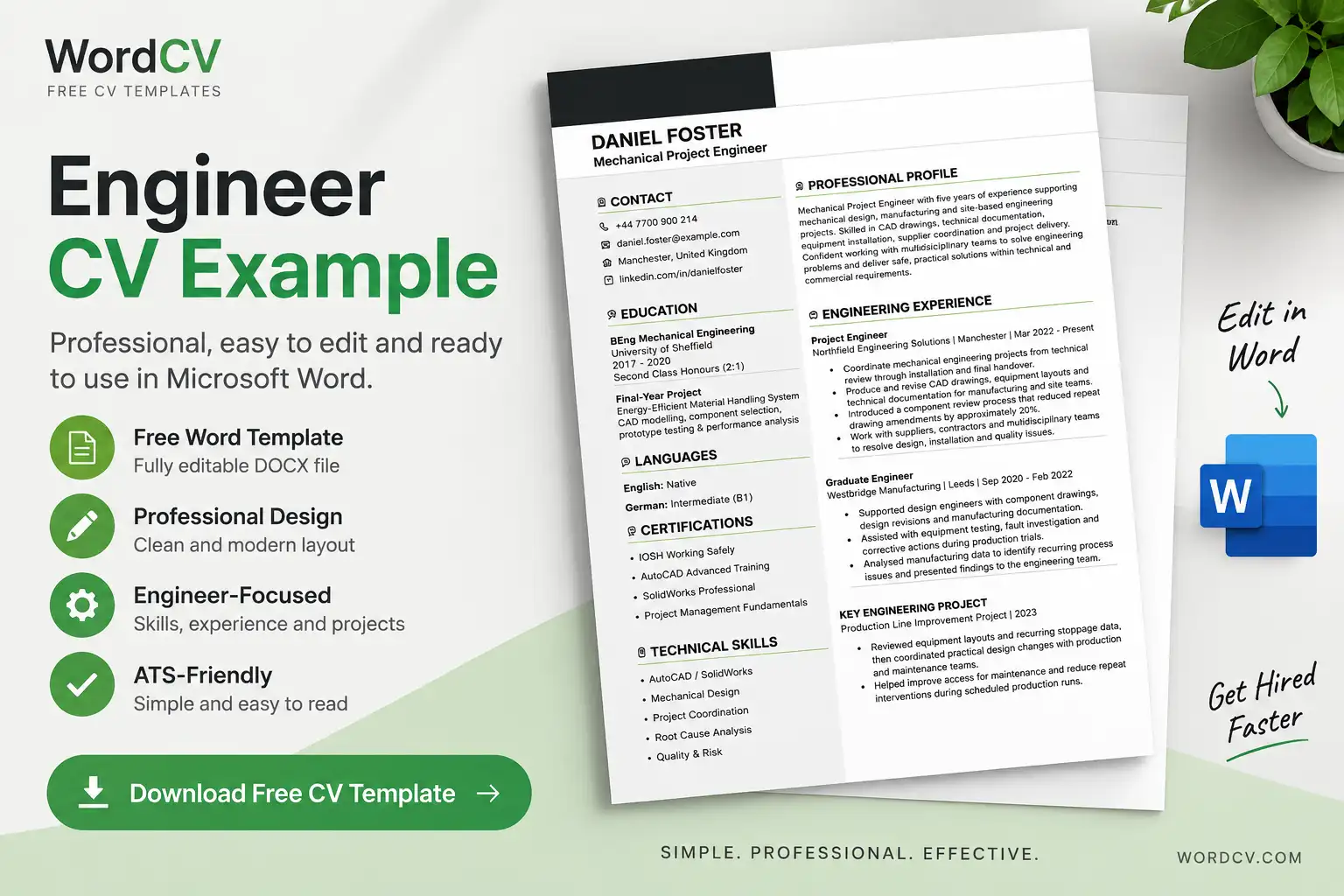

An engineering CV needs to do more than list qualifications and previous job titles. Employers need to see what you can design, analyse, improve, build or manage — and the evidence behind those claims.
This Engineer CV example shows how to present technical skills, engineering experience, projects and measurable achievements in a clear format. You can also download the editable Engineer CV template in Word and adapt it to your own engineering discipline.
Engineer CV Example
The example below is written for an experienced engineer, but the same structure can be adapted for mechanical, civil, electrical, manufacturing, project and other engineering roles.
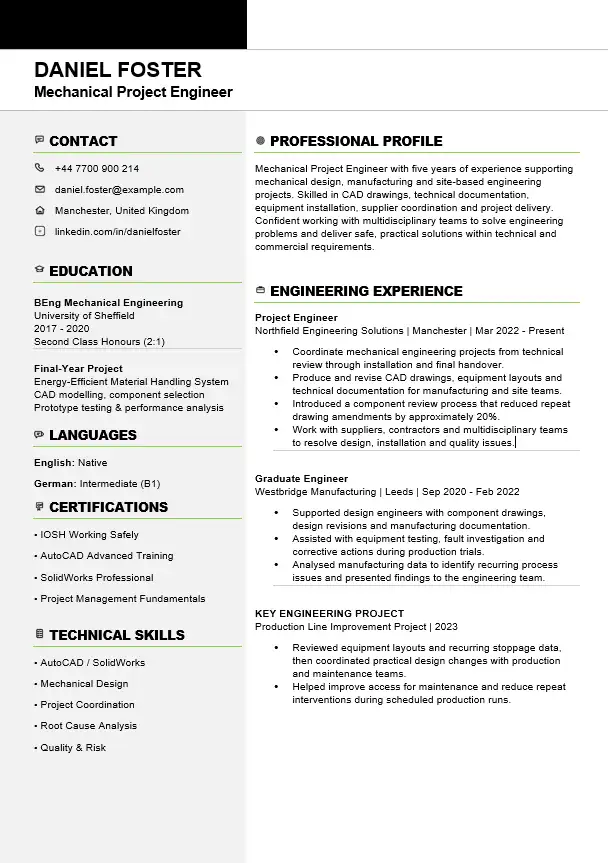
The Word version is fully editable, so you can replace the example content with your own qualifications, projects, software skills and engineering experience.
Engineering CV Sample
Daniel Foster
Project Engineer
Manchester, United Kingdom
+44 7700 900 214 · daniel.foster@example.com
linkedin.com/in/danielfoster
Professional Profile
Project Engineer with five years of experience supporting mechanical design, manufacturing and site-based engineering projects. Experienced in CAD drawings, technical documentation, equipment installation, supplier coordination and project delivery. Confident working with multidisciplinary teams to identify engineering problems, develop practical solutions and complete work safely within technical and commercial requirements.
Technical Skills
- AutoCAD and SolidWorks
- Engineering drawings and technical documentation
- Mechanical design and component selection
- Project planning and coordination
- Root cause analysis and problem-solving
- Quality control and inspection
- Risk assessment and health and safety
- Microsoft Excel and technical reporting
Engineering Experience
Project Engineer
Northfield Engineering Solutions | Manchester
March 2022 – Present
- Coordinate mechanical engineering projects from initial technical review through installation and final handover.
- Produce and revise CAD drawings, equipment layouts and technical documentation in response to project requirements.
- Work with suppliers, contractors and internal engineering teams to resolve design and installation issues.
- Introduced a revised component review process that reduced repeat drawing amendments by approximately 20%.
- Monitor project schedules, technical queries and outstanding actions to support delivery against agreed deadlines.
- Prepare engineering reports, risk assessments and project documentation for internal and client review.
Graduate Engineer
Westbridge Manufacturing | Leeds
September 2020 – February 2022
- Supported design engineers with component drawings, design revisions and manufacturing documentation.
- Assisted with equipment testing, fault investigation and corrective actions during production trials.
- Analysed manufacturing data to identify recurring process issues and presented findings to the engineering team.
- Worked with production and quality teams to improve technical instructions used on the shop floor.
Education
BEng Mechanical Engineering
University of Sheffield
2017 – 2020
Final-year project: Designed and evaluated an energy-efficient material handling system, including CAD modelling, component selection, performance calculations and prototype testing.
Additional Training
- Health and Safety in Engineering
- AutoCAD Advanced Training
- Project Management Fundamentals
What Makes a Good Engineering CV?
A strong engineering CV connects your technical knowledge to real work. Instead of filling the page with software names and generic skills, show where you used those skills and what happened as a result.
For example, writing “AutoCAD” in a skills section tells an employer that you know the software. Writing “Produced and revised AutoCAD equipment layouts for manufacturing and installation projects” provides evidence of how you have actually used it.
The same principle applies to project management, testing, design, analysis, quality assurance and problem-solving. Your CV becomes stronger when technical claims are supported by specific examples.
How to Write an Engineer CV
The exact content will depend on your engineering discipline and career stage, but most professional engineering CVs can be built around the following sections.
1. Contact Details
Start with your name, professional title, location, telephone number and professional email address. You can also include LinkedIn or a relevant engineering portfolio if it provides useful evidence of your work.
You normally do not need to use valuable space writing “Curriculum Vitae” at the top of the page. Your name and engineering specialism are more useful.
2. Engineer CV Profile
Your profile should quickly explain what type of engineer you are, your level of experience, your strongest technical areas and the kind of value you can bring to an employer.
Avoid a profile made entirely from phrases such as “hard-working”, “motivated” and “team player”. Those qualities are more convincing when the rest of the CV provides evidence for them.
Example: Mechanical Engineer with four years of experience in manufacturing and equipment design. Skilled in SolidWorks, CAD drawings, design verification and root cause analysis, with experience supporting projects from initial concept through testing and production.
3. Technical Engineering Skills
Make your technical skills easy to identify. Depending on the role, this may include engineering software, design methods, programming languages, testing methods, standards, manufacturing processes, analysis tools or specialist equipment.
Examples may include:
- AutoCAD, SolidWorks, Revit or other CAD software
- MATLAB, Python or engineering analysis tools
- Technical drawings and specifications
- FEA or simulation
- Testing and validation
- Root cause analysis
- Quality assurance
- Project engineering
- Risk assessment
- Data analysis
Do not add software simply because it is common in engineering. Prioritise the tools and techniques that are relevant to the position you are applying for.
4. Engineering Work Experience
List your most recent experience first. For each role, include your job title, employer, location and dates, followed by concise bullet points.
Engineering experience is usually more persuasive when each bullet explains an action and its context or result.
Instead of:
Responsible for engineering drawings.
Use something more specific:
Produced and revised mechanical assembly drawings in SolidWorks for new manufacturing equipment, incorporating feedback from production and quality teams.
5. Show Engineering Achievements, Not Just Duties
Where possible, include evidence of improvements you contributed to. Useful measures can include cost, time, downtime, defects, output, efficiency, project value, energy use, safety performance or delivery time.
For example:
- Reduced equipment downtime by 12% after identifying recurring mechanical failures and coordinating corrective maintenance.
- Redesigned a component that reduced material use by 8% while maintaining required performance.
- Supported delivery of a £250,000 equipment installation project within the planned commissioning period.
Only use figures you can genuinely support. A credible specific result is more useful than an impressive number with no context.
6. Engineering Projects
Projects can be particularly valuable for graduates, students and engineers whose most relevant technical experience was gained outside a formal job title.
For each important project, consider showing:
- the engineering problem or objective;
- your individual contribution;
- software, tools or methods used;
- technical constraints;
- testing or analysis performed; and
- the final result.
A final-year university project, Formula Student work, engineering society project, personal design project or placement assignment can provide useful evidence when it is relevant to the vacancy.
7. Education and Engineering Qualifications
Include your engineering degree or other relevant qualifications with the institution and dates. Recent graduates can give more space to relevant modules, dissertations, laboratory work and final-year projects. Experienced engineers usually need much less detail.
Professional registrations, licences and certifications can also be included when relevant to the role or country in which you are applying.
Engineer CV Skills
There is no single list of skills that every engineer should place on a CV. A civil engineer, software engineer and mechanical engineer may require very different technical abilities.
However, employers often need evidence of a combination of technical and transferable skills. Seven useful areas to consider are:
- Technical knowledge relevant to your engineering discipline.
- Problem-solving and the ability to investigate technical issues.
- Analytical thinking and evidence-based decision-making.
- Project management and planning.
- Communication with technical and non-technical stakeholders.
- Teamwork across engineering and operational functions.
- Attention to detail in calculations, drawings, specifications and documentation.
The strongest CV does not simply list these skills. It shows evidence of them through projects, work experience and achievements.
Engineering CV Format
A clear engineering CV format makes it easier for recruiters and hiring managers to identify your qualifications, technical skills and relevant experience.
A practical order for many engineers is:
- Name and contact details
- Professional profile
- Technical skills
- Engineering experience
- Projects
- Education
- Professional qualifications and training
- Additional relevant information
This order is not fixed. A recent engineering graduate may place education and projects above employment, while an experienced engineer will usually give professional experience greater prominence.
How Long Should an Engineering CV Be?
For many professional job applications, one or two pages is a useful target. The correct length depends on your experience, location and the employer’s instructions.
A graduate with limited experience may be able to present everything effectively on one page. An experienced engineer with several relevant projects and positions may need two pages. Academic and research CVs can follow different conventions and may be considerably longer.
The aim is not to reach a particular page count. Give enough information to demonstrate your suitability without filling the CV with unrelated detail.
Engineering CV Examples for Students
Engineering students do not need to pretend that university projects are full-time employment. Instead, use the experience you genuinely have and explain its relevance.
Your CV can draw evidence from:
- engineering coursework and design projects;
- laboratory work;
- final-year projects;
- industrial placements and internships;
- Formula Student or engineering societies;
- CAD, programming or personal technical projects;
- part-time work that demonstrates teamwork, responsibility or communication.
Our Student CV Template for Word provides a broader structure for students who have limited professional experience.
If you have recently completed your degree, the Graduate CV Template also shows how to give education, projects and early career experience more prominence.
Engineering Placement CV
For an engineering placement or internship, employers understand that you may not have years of industry experience. Concentrate on evidence that you can apply engineering knowledge in practice.
Relevant modules, design projects, laboratory work, software skills, competitions and technical societies can all help. Tailor these examples to the placement rather than sending the same engineering CV to every employer.
Should You Use the Same CV for Every Engineering Job?
No. Engineering job titles can cover very different responsibilities. Review the vacancy and identify the technical knowledge, software, project experience and transferable skills the employer emphasises.
Then make the most relevant evidence easier to find. This does not mean copying every keyword from the job advert. The wording still needs to accurately describe your own experience.
If you are concerned about automated screening, our ATS-Friendly CV Template for Word explains how to use straightforward headings and a readable structure. No template can guarantee compatibility with every applicant tracking system.
Engineer CV Template Word or PDF?
A Microsoft Word file is convenient while you are editing your CV because you can change the wording, sections and spacing easily. That is why the downloadable Engineer CV template Word file on this page is provided in DOCX format.
For the final application, check the employer’s instructions. Some recruitment systems accept both Word and PDF files, while others specify a particular format. If no format is stated, use a file type that preserves the layout and is accepted by the application system.
If the layout changes while you are editing the template, see How to Edit a CV Template in Word.
Engineer CV Example vs Engineer Resume Example
The terms CV and resume are used differently around the world. In many countries, employers use “CV” for a standard job application document, while “resume” is more common in others.
The safest approach is to follow the terminology and application instructions used by the employer. The engineering experience, technical achievements and project evidence discussed in this guide remain useful whichever term is used.
Common Engineering CV Mistakes
- Listing software without context: show where you used important tools.
- Writing only job duties: include engineering problems, actions and outcomes.
- Using one CV for every engineering role: prioritise evidence relevant to the vacancy.
- Overloading the page with technical jargon: remember that the first reader may be a recruiter rather than an engineer.
- Hiding projects: students and graduates can use relevant projects as important evidence.
- Adding unsupported percentages: only quantify results when the figure is genuine and defensible.
- Making the layout unnecessarily complex: readability is more important than decorative design.
Engineer CV Checklist
- Is your engineering discipline immediately clear?
- Does the profile explain your main technical strengths?
- Are the most relevant software and engineering tools easy to find?
- Does your experience provide evidence instead of simply listing responsibilities?
- Have you included relevant engineering projects?
- Are genuine achievements quantified where possible?
- Is the CV tailored to the engineering vacancy?
- Are dates, job titles and qualifications consistent?
- Have you checked spelling, technical terminology and formatting?
- Have you used the file format requested by the employer?
Engineer CV FAQs
How do I write a good CV as an engineer?
Start by identifying the technical and transferable skills required by the vacancy. Build your CV around relevant evidence from engineering roles, projects, placements and education. Describe what you did, how you did it and, where possible, the result.
What skills should I put on an engineer CV?
Include technical skills relevant to your discipline and the specific job, such as CAD, analysis, programming, testing, design or project tools. Combine these with evidence of problem-solving, communication, teamwork and project management where relevant.
Should an engineering CV include projects?
Yes, when the projects provide useful evidence for the position. Projects are particularly valuable for students and graduates, but experienced engineers can also use selected projects to demonstrate specialist knowledge, project scale or technical achievements.
Should I include every engineering software package I have used?
No. Prioritise tools you can use confidently and that are relevant to the vacancy. A focused skills section supported by evidence in your experience is usually more useful than a long list of software names.
Can I use this CV for mechanical, civil or electrical engineering jobs?
The overall structure can be adapted to different engineering disciplines, but the content should change. A mechanical engineer may emphasise CAD, design and manufacturing, while a civil engineer may focus on infrastructure, site work and technical standards. An electrical engineer may need to highlight systems, testing, controls or power-related experience.
Can ChatGPT write an engineering CV?
AI tools can help organise information, suggest alternative wording or identify details that may be missing. However, the technical facts, project responsibilities, software knowledge and achievements must accurately reflect your own experience. Review every statement before using it in an application.
Download the Engineer CV Template for Word
Use the free editable Word template as a starting point, then replace the sample information with your own engineering experience, technical skills, education and projects.
For more job-specific examples, browse our CV Examples, or explore our free CV templates for Microsoft Word.