
Changing careers does not mean starting your CV from zero. In most cases, you already have useful experience — the challenge is showing how that experience relates to the role you want next.
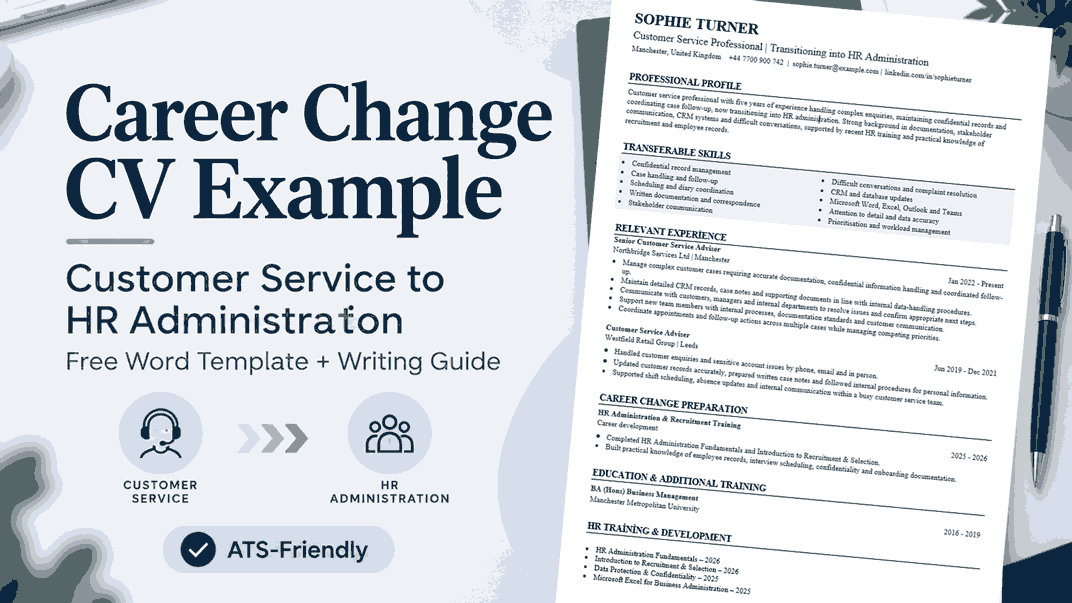
This Career Change CV example shows how to reposition existing experience, highlight transferable skills and explain a professional transition without pretending you already have years of experience in the new field. You can also download the editable Microsoft Word template and adapt it to your own career change.
Career Change CV Example
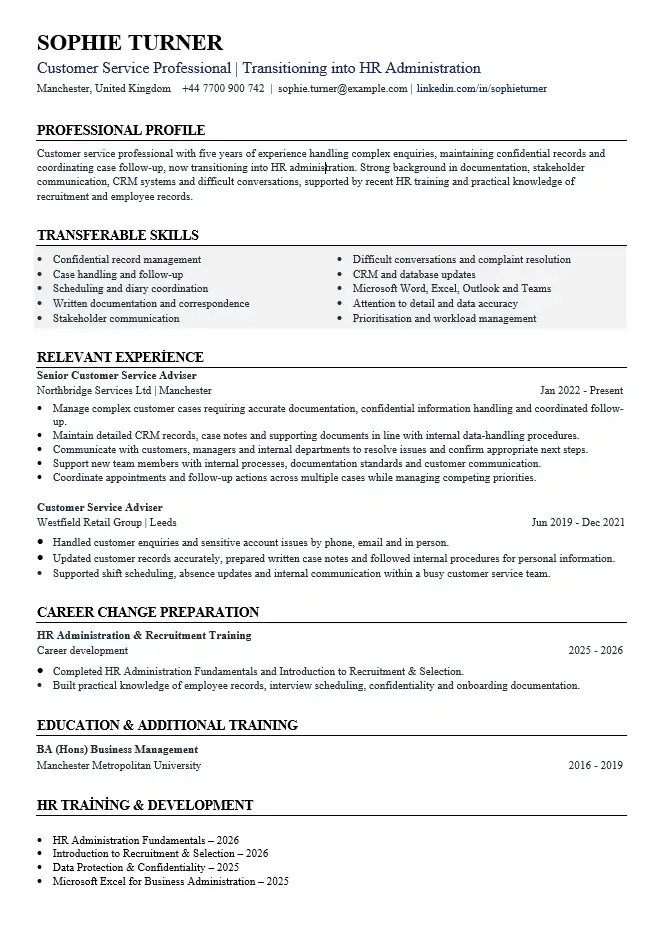
Our completed example follows a customer service professional moving into HR administration. The candidate does not invent HR experience. Instead, the CV gives greater emphasis to confidential record handling, case follow-up, difficult conversations, documentation, scheduling and stakeholder support.
The template is free to edit in Microsoft Word. No account or sign-up is required. Replace the sample details with your own experience, training and target role.
Completed CV Sample
Sophie Turner
Customer Service Professional Transitioning into HR Administration
Manchester, United Kingdom
+44 7700 900 742 | sophie.turner@example.com
linkedin.com/in/sophieturner
Professional Profile
Customer service professional with five years of experience handling complex enquiries, maintaining confidential records and coordinating case follow-up, now transitioning into HR administration. Strong background in documentation, stakeholder communication, CRM systems and difficult conversations, supported by recent HR administration training and practical knowledge of recruitment and employee records.
Transferable Skills
- Confidential record management
- Case handling and follow-up
- Scheduling and diary coordination
- Written documentation and correspondence
- Stakeholder communication
- Difficult conversations and complaint resolution
- CRM and database updates
- Microsoft Word, Excel, Outlook and Teams
- Attention to detail and data accuracy
- Prioritisation and workload management
Relevant Experience
Senior Customer Service Adviser
Northbridge Services Ltd | Manchester
January 2022 – Present
- Manage complex customer cases requiring accurate documentation, confidential information handling and coordinated follow-up.
- Maintain detailed CRM records, case notes and supporting documents in line with internal data-handling procedures.
- Communicate with customers, managers and internal departments to resolve issues and confirm appropriate next steps.
- Support new team members with internal processes, documentation standards and customer communication.
- Coordinate follow-up actions and appointments across multiple cases while managing competing priorities.
- Prepare written correspondence and case summaries for review by senior colleagues.
Customer Service Adviser
Westfield Retail Group | Leeds
June 2019 – December 2021
- Handled customer enquiries and sensitive account issues by phone, email and in person.
- Updated customer records accurately and followed internal procedures for personal information.
- Resolved complaints and escalated complex cases to appropriate managers.
- Supported shift scheduling, absence updates and internal communication within a busy customer service team.
HR Training & Development
- HR Administration Fundamentals – 2026
- Introduction to Recruitment & Selection – 2026
- Data Protection & Confidentiality – 2025
- Microsoft Excel for Business Administration – 2025
Education
BA (Hons) Business Management
Manchester Metropolitan University | 2016 – 2019
Start with the Role You Want, Not the Job You Have
One of the easiest mistakes in a career-change application is updating an old CV by simply adding your latest job. That produces an accurate career history, but it may not explain why you are suitable for a different type of work. Instead, start by studying several vacancies for the role you want. Look for responsibilities and requirements that appear repeatedly.
For example, someone moving into HR administration might repeatedly see:
- employee record maintenance;
- confidentiality;
- interview or meeting scheduling;
- recruitment administration;
- accurate documentation;
- communication with employees and managers;
- Microsoft Office skills; and
- organisation and prioritisation.
You can then compare these requirements with your existing experience. The aim is not to force a connection where none exists, but to identify genuine overlap.
Build a Professional Inventory Before Rewriting Your CV
Before deleting old experience, make a larger private list of what you have actually done throughout your career. This does not become the final CV. It gives you a complete inventory from which to choose the evidence that matters for your next role.
Include:
- technical and job-specific skills;
- communication and leadership skills;
- projects and responsibilities;
- problems you solved;
- processes you improved;
- systems and software you used;
- training and qualifications;
- work with customers, colleagues or stakeholders; and
- achievements you can explain clearly.
This often reveals useful experience that was hidden behind an old job title.
Match Existing Experience to the New Role
Once you understand the target position, sort your existing experience by relevance.
| Priority | What it means | What to do |
|---|---|---|
| High relevance | Directly supports the new role | Give it strong visibility and evidence |
| Transferable | Useful in the new role with some context | Explain why the experience matters |
| Low relevance | Does not support the target position | Shorten or remove it where appropriate |
This keeps the CV focused without pretending your previous career never happened.
How to Identify Transferable Skills
Transferable skills are abilities developed in one role that remain useful in another. They become more convincing when you explain the context rather than simply listing them.
| Previous experience | How it can translate |
|---|---|
| Handling difficult customer complaints | Managing sensitive conversations and maintaining professionalism |
| Maintaining CRM case notes | Accurate employee or applicant record management |
| Coordinating customer appointments | Interview, meeting or training scheduling |
| Training new customer service staff | Employee onboarding support and process guidance |
| Working with confidential account information | Handling sensitive employee information responsibly |
| Preparing case summaries | HR documentation and written correspondence |
The wording should remain accurate. Customer records are not employee records, and customer onboarding is not automatically HR onboarding. The value comes from explaining the underlying skill without changing what you actually did.
Write a Profile That Explains the Direction of Travel
A career-change profile should answer three questions quickly:
- What experience do you already have?
- Which parts of it are relevant to the target role?
- What are you moving towards?
Example:
Operations professional with seven years of experience coordinating projects, reporting and cross-functional teams, now transitioning into project management. Experienced in scheduling, stakeholder communication, process improvement and delivery tracking, supported by recent project management training.
This is stronger than:
Hard-working professional looking for an exciting new challenge and a change of career.
The second version explains motivation but provides almost no evidence.
Rewrite Experience Without Rewriting History
You can change the emphasis of a job without changing the truth.
Imagine a customer service adviser applying for HR administration.
Original wording:
Answered customer calls and dealt with complaints.
More relevant wording:
Managed sensitive customer cases, maintained accurate CRM documentation and coordinated follow-up actions with internal departments.
The work has not been invented. The second version simply identifies the parts of the responsibility that are useful for the new application.
Should You Use a Skills-Based CV?
A skills-based or functional CV can appear attractive when your previous job titles seem unrelated to the role you want. However, hiding dates and employment history completely can make the document harder to understand.
For many career changers, a combination format is more practical:
- a focused professional profile;
- a visible transferable-skills section;
- normal reverse-chronological employment history;
- relevant achievements prioritised within each job;
- training or qualifications connected to the new field.
This keeps your work history transparent while allowing the most relevant evidence to appear earlier.
Use Training to Show That the Change Is Deliberate
If the new role requires knowledge you do not yet have, relevant training can demonstrate that your career change is more than an idea. Useful evidence might include:
- a recognised course;
- a professional qualification;
- a portfolio project;
- voluntary experience;
- shadowing or internal project work;
- industry software training; or
- relevant professional development.
Do not collect qualifications simply to make the CV longer. Focus on gaps that appear consistently in the jobs you want.
What If You Have No Direct Experience?
No direct experience does not mean no relevant experience. Suppose you are moving from retail management into project coordination. Your previous role may already involve:
- staff scheduling;
- supplier coordination;
- deadline management;
- budget responsibility;
- reporting;
- team leadership; and
- handling operational problems.
The important question is whether you can demonstrate those responsibilities clearly and connect them to the requirements of the target position. If you have very limited professional experience overall, our No Experience CV Template may be a better starting point.
Should You Explain Why You Are Changing Careers?
Your CV does not need a long explanation of why you want to leave your current profession. A short line in the profile can establish the transition. Use the rest of the document to show why the move makes sense. Personal reasons, dissatisfaction with a previous employer or detailed explanations of redundancy normally belong outside the CV unless they are directly relevant. Your cover letter or interview gives you more space to explain the motivation behind the change.
Do Not Remove an Entire Career Just Because It Looks Different
Experienced applicants sometimes overcorrect by deleting many years of employment because the industry is different. That can remove valuable evidence of progression, responsibility and professional maturity. Instead, reduce detail progressively.
Your most recent and relevant roles can receive several useful bullet points. Older or less relevant jobs may need only the title, employer, dates and one or two lines of context.
Think About the Story, Not Just the Keywords
Keyword matching matters, particularly when job applications are screened digitally, but a career-change CV still needs to make sense to a person.
The reader should be able to follow a simple story:
This is what I have done → these parts are relevant → this is what I have done to prepare for the change → this is what I can contribute next.
If that connection is unclear, adding more keywords will not fix the underlying problem.
Make Your CV and LinkedIn Profile Tell the Same Story
If your CV presents you as someone moving into a new field but your LinkedIn headline and About section still position you entirely around the old career, the message can feel inconsistent. You do not have to erase your previous professional identity. Instead, make the direction of travel understandable across both.
For example, a LinkedIn headline might combine current expertise with the target area:
Customer Service Professional | HR Administration Training | Employee Support & Documentation
Keep the wording truthful and avoid presenting a target job title as a role you already hold.
Common Mistakes
- Using the old CV unchanged: adding a new profile does not make the rest of the document relevant.
- Hiding previous experience: a different industry does not make your earlier achievements worthless.
- Listing transferable skills without evidence: show where and how you developed them.
- Inventing experience in the target field: reframe real responsibilities instead.
- Making the profile entirely about motivation: explain what you can offer.
- Applying before understanding the target role: compare several job descriptions first.
- Trying to close every possible skill gap: prioritise recurring, job-critical requirements.
- Overusing a functional format: keep employment dates and career history easy to understand.
- Keeping every old responsibility: remove details that distract from the new direction.
- Using unrelated CV and LinkedIn positioning: keep your professional story consistent.
Frequently Asked Questions
How do I write a CV when changing careers?
Start with the requirements of your target role, identify relevant and transferable experience from your existing career, and prioritise that evidence throughout the CV. Keep your work history accurate while changing the emphasis of each section.
What should I write in a career-change personal statement?
Explain your current professional background, the experience or skills that transfer to the new role, and the direction you are moving towards. Recent training or qualifications can also help demonstrate commitment to the change.
Should I use a functional CV for a career change?
A fully functional CV is not always necessary. A combination format can highlight transferable skills while keeping employment history and dates clear.
Should I include irrelevant jobs?
Usually yes if they form an important part of your employment history, but you can reduce the amount of detail. Give more space to recent responsibilities and achievements that support the target role.
How do I change careers without direct experience?
Use transferable experience, relevant projects, training, qualifications, voluntary work or internal responsibilities to demonstrate potential. Be clear about what you have actually done and avoid presenting training as professional experience.
Do I need to explain my career change in the CV?
A brief explanation in the professional profile is usually enough. The CV should focus mainly on your suitability for the target role. Your cover letter and interview can provide more detail about motivation.
Download the Free Word Template
Download the editable Word example and adapt the profile, transferable skills, employment history and training sections to your own career transition.
For other formats and examples, explore our CV Examples, Professional CV Template and ATS-Friendly CV Template for Word.